)
1897 年11 月,德国以山东曹州府“巨野教案”为借口,派海军远东舰队侵占胶澳(胶州湾),第二年即1898年4月初夏,肠道传染病流行,4名德国军人病死,中国平民死者颇众,德军远东舰队遂拨出9个毡棚,在观象山南麓建立了帐篷式的野战医院,主要供德国军人就诊。同时殖民统治者为笼络人心,也对青岛居民开设门诊。该院遂成为胶澳最早的医院,也标志着西方医学传入青岛。
帐篷式野战医院只适用于做急救的临时病房,不足以安置所有病人。不久,又安装了大型多克式棚房,仍不够用。德国占领者为巩固其殖民统治,决定立即建造医院,称“建成后除为德国人和华人治病外,并可作为德国军人和来华人士的疗养院”。
1898 年10 月至 1899年10月,医院完成第一期建筑工程,年底交付使用。新建医院命名为“大德胶澳督署医院”,俗称“总督府医院”,负责人为德国医学博士马尔姆(Mar-tim)教授。1904年又在郊区建立李村医院,是最早的分院。德国占领者从1898年到1906年,共花费198万马克,将医院建成。
跨越百年——青岛大学医学院附属医院志(1898—2008)关于建院初期的情形,1910年柏林出版的《德国在胶州地区卫生事业发展备忘录》中有较为详细的记载:
(一)1898年度由于青岛的气候条件适宜,雨季来到之前,人们的健康状况都是良好的。进入雨季后,肠炎经常发生,欧籍居民乃至驻军与华人都有染上此病者。后来又发现了一系列痢疾甚至还有疟疾病例。驻军中有4人病故。风湿性关节炎也屡有发生。
海军部门提供了9个毡棚用做病房,该病房也提供平民服务。毡棚很适于用做急救病房,但不适应当地的气候。因此,建造新医院是刻不容缓的。建筑工作正在加紧进行,明年雨季开始前有希望落成并投入使用。新建军用医院也将暂时接收前来就诊的平民。
胶州保护区尚无专门的华人医院。但派往胶州的海军军医已设立了门诊,华人可免费就医,只需交付少量的药品费和敷料费。
如果说卫生保健情况迄今仍不能尽如人意,这也是每个殖民地在初创阶段难免的现象之一,还有严重的住房匱乏和饮用水不足的问题。随着这些问题的解决,殖民地的卫生保健状况便可逐步改观,并有希望达到接近于德国本土的水平。
(二)1898~1899年度野战医院建造一所野战医院是一项最迫切的事情,因为那些运来的多克式棚房虽然费了大量的安装工作也不足以安置所有的病人。已选中一块很好的朝南的坡地,这是位于总督府山和信号山之间地势较低的一块地方。这所野战医院计划安置156张病床,同时也考虑到接纳老百姓就诊的需要。为了安置这些床位将建造3幢两层的病房楼和1幢隔离病房楼。对附属建筑物的设计是1幢带厨房、储藏室和下级官员宿舍的生活,1幢带敷料室的药局大楼,2幢带护卫人员和中国工人宿舍的附属楼,1幢带消毒室的洗衣房,1个车库及太平间。
这些建筑物中已经建成并交付使用的是隔离病房楼、生活楼、2幢护卫人员宿舍与药局楼。1幢两层的病房楼在总督府上次报告后已经进展到可以在1899年12月交付使用的程度。第二幢两层的病房楼、车库及洗衣房现已开工。
为了暂时安置病人,已将运抵此地的一个大型多克棚房搭了起来并布置就绪。此外还建成了一个冰窖。
供水由一台电动机驱动的压力水管从水井中汲取。下水排到已连接至此处的下水道中。建筑中颇感困难的是这里的梯坡地形,在一定程度上需要搬动大量土方。
(三)1899~1901年度旧的野战医院一直使用到1899年底,以后就不再用做医院了。亭园式的新医院目前已大部分竣工并交付使用。第一座较大的建筑物(1号楼)已于本报告年度落成。内设 39张病床。除了两间各有16个床位的大病室外,还另有7个单间及洗漱池、淋浴室和清洗设施,以及1个主治医生办公室和若干间医务人员的宿舍。在医院建设中完工的还有一座名为奈密申的房子和洗衣房。本年度一开始时一座较大的病房楼(2号楼)就开始施工,目前已经建成,面积为893平方米,可容纳35张病床。这幢房子除有两间大病房和3间小病房外,还有一个附设着包扎室和包扎器械室的专用手术间,此外还有1间助理医生的住. 2.绪言历史沧桑一百一十年房、5间医务人员的宿舍。
医院另外的几个病房和其他建筑需要加快施工进度,争取在冬季到来之前,医院能够接纳数量较多的病人。另一座占地664平方米、可设30张床位的较大的病房楼(4号楼)已建成,即可交付使用。目前仍有一个医务人员专用餐厅和细菌化验室仍在施工。已经设计完毕的最大的一个病房楼(3号楼),即将施工。该楼设有眼科、耳科和神经科病房,还设有X光透视室和一位已婚医院监察官和两位医助的宿舍,以及一间宽敞的礼拜堂和医务人员的居住房间。这幢楼与2号楼一样也有低压暖气锅炉。目前从发展需要看拟扩建下水道网络。现已着手加固汽车道和人行道。医院为暂时解决供水问题打了3口井,使用压力泵将水量最足的一口水井中的水压入高耸的蓄水器中,再向低处的建筑物供水。
自来水工程完工后,目前正在使用的管道可接上自来水再用。当电厂的输电电缆经过医院所在地时,可望在建筑物及其通路上使用电力照明。
1901年,自来水接通供水,下水道安装完工,污水排入前海。
(四)1902年度野战医院已大体建成。3号病房楼已接近完工,最近一段时间便可交付使用。另外还修了一个花园。原设计中确定的建筑物尚未建成的只有太平间和围墙了。
由殖民地病员护理妇女协会派出的4名护士的工作很忙碌。她们的工作极受欢迎。
关于早期医学的分科与职员情况、医疗收费标准,1913年出版的《胶州湾》(日文,田原帧次郎著)中有零星记载:
在青岛医院中,设备完善者为总督府医院,即海军医院,位于葛巴门托山麓的俾斯麦街,视野宽阔,空气新鲜,规模颇大,设备齐全。内外科、花柳病科、耳鼻科、精神病科、妇科、小儿科、肺病科等无不具备。还设有隔离病房、妇女分隔室。本来只限于海、陆军人就医,但也为一般民众诊治。然而听说仍因是以海军为中心,对其他人冷淡,市内评价不佳。
住院费及药费合计一等为7元,二等为5元5角,三等为2元5角。现在的职员有院长弗斯医生、乌奥尔普医生、温托医生、瓦歇尔医生、乌尔利希斯医生、根茨肯医生。米尤勒尔医生、赫尔兹堡男爵、药局主任布茨夫霍尔茨等,都是海军军医兼任的。
医生的诊疗费是经青岛开业医生会议议决并于1902年10月16日经民政长官认可的,规定如下:
在医生处的诊疗费为3元,资产不多者为2元。
去病人处的诊疗费为5元,资产不多者为3元。
夜间诊疗费(自下午9時起至翌晨7时)另加半价。
出诊超过1小时时,每小时增加1元。
一年一人的特约诊疗费为70元,资产不多者为50元。
一年一家庭的特约诊疗费为300元,资产不多者为100元。
接生费为50元,资产不多者为30 元。
大手术费另定。
一个月一人的特约诊疗费为25元。
诊断书为5~15元。
•3•
跨越百年———青岛大学医学院附属医院志(1898—2008)
二、第一次日占、北洋政府和南京政府统治时期(1914年11月~1937年6月)
)
1914 年 11 月 11 日,日本借第一次世界大战之机取代德国,侵占了胶澳,医院被日本侵略军(自称“守备军”)占用,改称陆军病院,由陆军三等军医正我妻孝助之任院长。尔后,又开设了济南、坊子两个分院。
日本侵占胶澳后,日本军政要员及资本家蜂拥而入,争先恐后来胶澳办实业,日侨人数猛增。
1915年5月,日本占领当局在现江苏路19号处开设了青岛疗病院,同时颁布了《青岛疗病院规则》,我妻孝助之兼任院长。
1916年3月,日本占领当局修改《青岛疗病院规则》,将疗病院划归“军政委员长”管辖,并将担负治疗妓女性病的“海泊町”诊疗所、“叶樱町”病室及台西镇传染病室划归疗病院。6月,青岛疗病院改名青岛病院并迁入院内。至此,院内形成两部分,北面为陆军病院,南面为青岛病院。
1917 年4月,李村诊疗所划归青岛病院。称为李村分院。9月,陆军三等军医正田岛清十郎任陆军病院院长。10月日本占领当局对胶澳改军管为民政,发布了《民政部医院规则》,青岛病院由“守备军”民政部管辖,“守备军”军医部长、陆军一等军医正村山有任代理院长,其通过改革诊疗组织,招聘医师,充实设备,扩大了医院的规模。
1918 年3月,村山有调离,由原陆军病院院长田岛清十郎代理青岛病院院长。
1919年4月,坐落在四方机车车辆工厂外的四方医院划归青岛病院,称为四方分院。
11月,在“胶州町”新建普济医院,作为青岛病院的分室。
>1920年5月,由“守备军”民政部专用医师、军医部长、医学博士、陆军一等军医正长野文治代理青岛病院院长。
1922年12月,日本虽被迫向中国北洋政府交还青岛主权,但在青岛仍保留了大量特权和利益,在政治、经济、文化、军事上保持了强大势力,成为日本对华侵略扩张的重要基地。中日双方曾就青岛病院的归属问题进行过几次谈判,日方以投资巨大为借口仗势坚持继续经营青岛病院。医学士铃木又任青岛病院院长。
1925年,日本外务省决定由财团法人同仁会接管经营青岛病院。3月 22 日,该会派理事小野一郎到胶澳办理手续,铃木又继任院长。1927年3月,同仁会青岛病院更名为青岛医院。翌年6月,医学士栗本定治郎任院长。
1929年4月15日,南京国民政府接管胶澳,改称青岛,设专员公署。7月,成立青岛特别市,直属南京政府。翌年9月,取消特别市名义,设青岛市政府。由于国民党推行“攘外必先安内”的政策,不向日方交涉收回医院,医院仍隶属于日本同仁会。
三、第二次日占时期(1937年7月~1945年8月)
)
1937年7月7日,日本侵略军在北京卢沟桥附近,以军事演习为名突然向当地中国驻军发动进攻,第 29 军奋起抵抗,中国抗日战争从此开始。8月20日,日本内阁正式批准进·4•
绪言 历史沧桑一百一十年
攻青岛的计划,并组织了入侵青岛的部队。正当青岛战争一触即发之际,中国军队在上海向侵华日军展开猛烈反击,日军遂将原定用于青岛作战的陆战队紧急派往上海。继之,日本领事馆和侨民撤离青岛。9月,东北军到青岛接防,中共东北军工委帮助青岛恢复了党的组织,在全市开展了抗日宣传和组织活动。11月下旬,青岛形势日益紧张,山东大学及重要科研单位、企业陆续西迁,大批居民离开市区。12月27日,沈鸿烈率市政府职员和保安队在未见日军的情况下撤离青岛。
1938年1月10日,日本侵略军第二次侵占青岛,医院被日本陆军占用,成为陆军医院。同仁会青岛医院被编为战时医疗组织,改称同仁会青岛医院诊疗班。栗本定治郎任班长,只在现江苏路19号处开设门诊。尔后,在现江苏路43号处设40张床位的临时病房,在台东、台西镇各增设1个诊疗所。
1940年6月,栗本定治郎将台西镇诊疗所移交青岛市卫生局,撤销了台东镇诊疗所。10月,陆军医院迁出,医院逐步恢复并扩大业务。1941年11月,改称同仁会青岛诊疗班。1944年12月,栗本定治郎离任,由青岛医学专门学校校长、日本海军中将田中朝三博士兼任班长。
四、南京国民政府统治时期(1945年9月~1949年5月)
1945年8月15日,日本战败无条件投降。11月6日,青岛市政府派教育局长孟云桥、博济医院院长陈志藻等一行接收同仁会青岛诊疗班,指定王斐先为负责人,日籍医护人员纷纷回国,留下田中朝三等9人继续任职。1946年1月,南京国民政府教育部和社会部卫生署商定,将接收的诊疗班移交山东大学。3月1日,命名为“国立山东大学附属医院”,任命内科医师依克伦为院长。1947年初,山东大学医学院院长李士伟到任后,兼附院院长,依克伦任医学院教授。
作为山东大学医学院附属医院,医院规模、医疗设备、技术力量都有了一些发展。床位增至250张,业务科室有内、外、妇、儿等11个,医护员工340余人。逐步建立了医护工作制度,实行坐班门诊,住院医师24小时负责制等。先后聘任了在专业上有一定造诣的专家,如眼科潘作新,外科冯雁忱、戚天昌、张之湘,内科杨枫,妇产科何森,耳鼻喉科梁福临,皮肤科李景颐等,主要科室的技术力量有所加强,诊治一般常见病、多发病以外,还开展了一些疑难病的研究和治疗。“山大医院”的名称开始在群众中流传。
1946年,蒋介石在美国的支持下,发动内战,但屡遭失败。1947年初又重点进攻延安和山东。当时的青岛,物价飞涨,秩序混乱,民不聊生,医护人员工资菲薄,生活艰难,医院勉强维持,冬季无煤取暖,只得实行半日门诊。
1948年9月以后,中国人民解放军攻克济南并取得辽沈、淮海、平津三大战役重大胜利,青岛处于三面被包围、解放在即的形势。1949年2月,院长李士伟离院,乘海轮经上海去台湾。李临行前委托眼科主任潘作新教授代理院长。
五、青岛解放以后(1949年6月~2008年6月)
1949年6月2日青岛解放,医院从此获得新生。翌日,中国人民解放军青岛市军事管
跨越百年——青岛大学医学院附属医院志(1898—2008)
制委员会派出王滋才、王乐三为军代表接管医院,医院改称山东大学医学院附属医院。
王滋才为首席军代表,潘作新任院长,医院隶属华东军政委员会卫生部和山东大学。1951 年 3 月,华东大学奉教育部命令由济南迁来青岛,与山东大学合并,成立新的山东大学,校长华岗任命著名解剖学专家、医学博士沈福彭教授任院长,王滋才任副院长。在中国共产党和人民政府的正确领导下,医院呈现出一派新的气象。
1956 年 3 月,中华人民共和国高等教育部批准山东大学医学院在青岛独立建制,定名为青岛医学院。9 月 12 日,遵照山东省人民委员会指示,医院改称为青岛医学院附属医院,隶属省卫生厅和青岛医学院。1966 年开始的“文化大革命”给医院带来灾难性后果,造反派夺了医院的党、政、财大权,乱批乱斗,秩序混乱。大批干部和知识分子遭到摧残,医院名称也一度被改为“青岛白求恩医院”(1966 年 9 月~1972 年 7 月)。1976 年 10 月,经过拨乱反正,医院工作进入正常轨道。1993 年 12 月,国家教委批准青岛医学院并入青岛大学,改称青岛大学医学院。医院改称为青岛大学医学院附属医院。
20 世纪五六十年代,在沈福彭院长之后,先后由林纯之、张立文、刘华甫等同志主持医院工作。他们认真贯彻党的路线、方针、政策,聘请老中医进院,在专家教授中发展中共党员,依靠广大医护员工,克服各种困难,使医院工作不断向前发展。
新中国成立以后,我们国家经历了经济恢复、社会整顿以及一系列运动。医护员工经过政治学习和各项实践活动的教育锻炼,逐步树立了为人民服务的思想观念。在党的“面向工农兵,预防为主,团结中西医,卫生工作与群众运动相结合”的方针指引下,医院的各项工作主动适应国家和社会的需要。1951 年,医院先后派出三批抗美援朝医疗队和反细菌战医疗队(共 70 余人)。分别由冯雁忧、王滋才、张之湘、韩积义、杨枫带队,奔赴指定地点为抗美援朝志愿军伤病员服务,为卫生工作服务。不怕艰苦,忘我工作,张传钧等一批队员立功受奖。与此同时,医护员工踊跃为志愿军捐款捐物,田家琛等 5 位医护人员报名参加国防战线的医务工作。1976 年 7 月 28 日,唐山、丰南一带发生强烈地震的消息传到医院后,几天之内医院组织起两支队伍,赴唐山抢救治疗伤员和组织伤病员的转移。有的队员冒着生命危险到矿井下抢救伤员,使他们转危为安,朱翠芝、翁维权、董国英等被评为山东省抗震救灾积极分子。转移到本院治疗的 132 名伤员,治愈后护送离青。从 20 世纪 50 年代初,医院几乎每年都派出人数不等的医疗队(组),有时一年派出多达人数达百人以上,分别到工厂、农村进行防病治病,开展计划生育、医学调查和卫生知识宣传,足迹遍及青岛、烟台、昌潍、临沂等地。如 1958 年的赴日照防治血丝虫病医疗队、1965 年前后赴革命老区医疗队等,都受到当地干部群众的欢迎。为了加强西藏少数民族地区的医疗力量,1975 年、1977 年两次派出赴藏医疗队,队员在十分艰苦的条件下,全心全意为藏胞的健康服务。从 1954 年开始,按照省卫生厅的要求,先后与胶东、昌潍等 10 余所地县医院建立了业务指导关系,通过会诊、接收进修、定期去作学术报告等形式,给以切实有效的帮助;20 世纪 50~70 年代,先后调派医护骨干充实烟台、昌潍、临沂、滨州和胜利油田、三线建设等地的医院,促进和改善了山东省中部、东部城乡的医疗状况,提高了地县医院的医疗水平,发挥了一个省级综合医院的示范、辐射、骨干和带动作用。50 年代中期以后,还选派了多批医疗队赴蒙古、坦桑尼亚、塞尔尔,为改善这些国家的医疗卫生状况和人民健康,为拓展我国的国际交往作出了贡献。
绪言 历史沧桑一百一十年
十年“文化大革命”结束,党的十一届三中全会胜利召开。医院党政领导和广大职工,认真学习全会精神,解放思想,勇于创新,把工作重点转到以医疗为中心上来,贯彻执行党的一系列改革开放的方针政策。
经上级批准,1981年5月,刘华甫任院长兼党委书记;1985年1月,高绪孟任院长,李冰清代理党委书记;1985年7月,邹存玮任党委书记;1988年7月,门相宦任党委书记;1991年6月,谢德新任党委书记;1997年3月,王大文任党委书记,谷仁凯任院长;1998年3月苗志敏任院长;2007年8月,姜振家任党委书记。
1985年医院职工人数1127人,其中医、技、护理人员790人,行政管理人员74人,后勤人员166人,其他人员97人。在医、技、护理人员中,高级职称8人,中级职称118人,初级职称664人。医院占地面积66400.033平方米,建筑面积26246.11平方米,医疗用房25976.11平方米,办公用房270平方米,职工宿舍18404.01平方米。住院病人床位595张。医院诊疗人数为554335人次,其中门诊515151人次,急诊24203人次,健康体检1650人次,预防接种3826人次,入院9509人次,出院9469人次,住院病人治愈率61.9%,好转率27.3%,病死率3.4%,病床使用率90%,床位周转率15.8人次,平均住院日20.7天。全年业务收入5963648元,其中门诊收入3283648元,住院收入2680000元。
1993年,山东省医院分级管理评审团对医院的行政管理、后勤管理、医疗管理、护理管理及感染控制工作进行了为期4天的检查评审,医院基本标准分为965.5分,分等标准分为943.5分,达到了“三级甲等医院”的标准,山东省医院分级管理评审委员会认可医院为“三级甲等医院”,1994年3月,医院举行了“三级甲等医院”挂牌仪式,省卫生厅厅长张青林、副市长周迪颐、市卫生局局长臧爱民参加仪式并揭牌。医院成为青岛市首家“三级甲等医院”。
同年,医院床位使用率88.9%,床位周转率14.6%,年门诊量为444178人次,入院11939人次,出院11974人次,平均住院日21.9天,治愈率93%,好转率28.2%,死亡率2.0%,门诊抢救成功率89.5%,诊断符合率99.0%,无菌切口甲级愈合率99.8%,共组织全院性会诊402次,抢救危重病人2843人次,全年业务收入6904万元。
1998年,医院职工人数1507人,其中医、技、护理人员1197人,行政管理人员70人,后勤人员172人,其他人员68人。在医、技、护理人员中,正高级职称48人,副高级职称135人,中级职称347人,初级职称667人。医院拥有博士11人,硕士137人,本科343人。眼科博士点申报成功,开创了青岛大学培养博士研究生新篇章。
医院床位数扩大为1000张,提前实现了“九五”规划医院发展规模的目标,门诊就诊达637051人次,比上年同期增加20%,入院17612人次,比上年同期增加1708人次,出院17484人次,手术7838例,床位使用率达到95%,床位周转率20.1%,业务收入达到2.1亿元。
1999年1月22日,医院被青岛市委、市政府授予1998年度青岛市社会治安综合治理先进集体。2月,医院首例保留主动脉瓣的主动脉根部替代术、治疗升主动脉瘤合并主动脉瓣关闭不全——补救性冠状动脉成形术获得成功。3月6日,中华医学会青岛分会内分泌专业成立大会在医院召开。会议选举苗志敏为内分泌分会的主任委员。5月26日,苗志敏等3人获青岛市科技进步奖。
• 7 •
跨越百年——青岛大学医学院附属医院志(1898—2008)
3月,医院被省卫生厅确定为四所省级医疗机构改革试点单位之一。 10月,在全国省级综合性医院思想政治研究会第五届年会上,院党委被授予“全国省级综合性医院先进组织”称号。 2000年,医院实施了“加强人才及学科建设、加大对外开放交流、加快科研改革步伐”三大战略,进一步解决了发展后劲问题,从而完成了“三步走”改革的第一步。 同年,医院以聘任制为重点继续深化人事制度改革。首先通过对全院各类岗位的重新核编、设岗,相继完成了56个业务科室正副主任的聘任、护士长的聘任以及机关干部的聘任工作,并对后勤氧气站等6个班组负责人试点实行了竞争上岗。通过聘任,医院科主任总数由125人降到117人,平均年龄从46.7岁降到43.9岁,博(硕)士由40人增至49人。一些年轻骨干走到领导岗位,主任队伍日益强健。在干部聘任工作中,党政管理干部由78人减为59人,压缩24%,17名科级干部没有安排党政岗位,4名科级干部因考核不及格不再安排实职,45岁以上干部所占比例从68%降为56%,大专以上学历所占比例从43%提高为73%,中级以上职称所占比例保持在58%。 通过聘任,党政管理队伍的职数、年龄、学历以及职称结构等得到进一步优化。在职称评审和职改工作中,共有83人晋升高级专业技术职务,12人顺利通过了省高评委的评审。 创新建立了“首席医学专家”制度,采取来去自由、成果重奖的“柔性引进”政策,聘请了黎介寿、樊代明、王忠诚、张运、谢立信等院士和博士生导师共30多名医学权威领军学科发展,实现了引进一个名家,带起一个重点学科,开创一个特色专业,取得一流科研成果,培养一批骨干人才的“五个一”目标,使医院优秀人才站在巨人的肩膀上实现了快速成长。出台了《关于引进和聘用高层次人才的暂行办法》,创新了较为完善的人才引进评价体系,通过提供良好的待遇和优越的工作条件,吸引了大批海外优秀人才前来创业。医院引进博士7名、硕士24名,选拔、推荐在职攻读博士和硕士36名。至此,医院共有博士35人、硕士248人,归国留学人员56名。 同年,组织院内疑难危重病人全院会诊500多人次,组织参加外院会诊746人次,参加了崂山大火现场抢救、即墨11名民工中毒、6.23交通事故等重大抢救5起,多次顺利完成了国家领导人的重大保健任务。医院门诊人次87.5万人次,出院2.47万人次,手术11000多例。治愈好转率为92.5%,平均住院日14.1天,病床使用率100.4%,病床周转次数25.3,门诊与出院诊断符合率99.9%,手术前后诊断符合率99.8%,门诊抢救成功率95.7%,住院抢救成功率83.1%。 2001年1月,医院获“青岛市精神文明标兵单位”称号。 2月,口腔科主任李宁毅教授研究成果“腭裂汉语言语病理及语音矫治的综合研究”被确定为全省推广项目。眼科在糖尿病视网膜病变等领域的基础与临床研究方面取得了可喜的进展,相关课题通过专家鉴定达到国际先进水平,研究成果填补了该领域国内空白。 6月,卫生部副部长王陇德、医政司司长吴明江一行在省卫生厅、市卫生局领导陪同下来医院就全国“三项制度改革”工作进行视察。苗志敏院长代表医院介绍了医院概况、汇报了医院改革情况、病人选医生等工作。在听取汇报后,王陇德等领导对医院人事、分配、医药制度改革、学科建设与发展、病人选医生等工作情况给予了很好的评价,认为医院各项工作成效显著,医院改革工作走在全省乃至全国的前列。
绪言历史沧桑一百一十年同年,医院被授予“全国首批百姓放心医院”称号、“青岛市创建国家环境保护模范城市先进单位”、“青岛市爱国卫生运动先进集体”称号。
11月,日本驻华大使馆公使本佳夫来院,特意为院长苗志敏和副院长董颁发“日本驻华大使奖”。
2002 年,医院突出特色技术、构建服务网络,强化科室建设、探索绩效工资,进一步提升了医院的效率和效益,完成“三步走”改革的第二步。同年,医院职工1638人,其中医、技、护理人员1343人,党政管理人员63人,后勤人员167人,其他人员65人。在医、技、护理人员中,正高级职称62人,副高级职称201人、中级职称430人、初级职称650人。医院拥有博士40人、硕士240人、本科 275人。
同年,医院门、急诊人次达到86万,同比增长10%,出院3.07万人次,同比增长17%,住院实际占用达39万床日,同比增长5.3%,完成手术1.47万例,同比增长11.8%,平均住院日12.5天,同比降低1.3天,病床周转次数为29.2,床位使用率达102.4%,门诊与出院诊断符合率为99.8%,临床与病理诊断符合率为99.2%。全年危重病人抢救1476人次,成功率达90%以上。
同年,医院按照“以人为本、质量第一、量化分档、挂档分类、自主选择、综合评定、优等优酬、动态管理”的原则,在全国卫生系统率先创新实践了“科室综合目标分类管理”的新模式。充分调动了广大医护员工的内在潜力,并取得了预期效果。同时,创办了内部刊物《信息之窗》,提供一个互相沟通、学习的新平台。
同年,医院后勤改革按照“三步走”的总体构想,在顺利完成试点之后,进入第二阶段。
医院制定了《关于后勤服务社会化改革的实施意见》等一系列文件,成立了相关领导小组,4月份后勤服务总公司正式成立,7月份开始相对独立运行。
同年,医院被评为“全国百姓放心医院”;青岛市“卫生系统文明单位标兵”和“创建服务名牌工作示范点”。共有90多个国内兄弟单位来院学习交流,90多人次赴境外学习、进修、交流,美、德、日、韩、坦桑尼亚等多个国家专家组或代表团来院访问,签订交流、培训协议3项,两位外国专家受聘为医院的名誉教授。
2003 年,面对SARS 这场突如其来的疫情,医院干部职工在党中央的正确领导下并肩作战,以最快的速度建立了指挥体系,建设了发热门诊和专门病房,及时召开了动员、誓师大会,组织一切力量进行了科学防治,最终战胜了SARS疫情。为此,国务院督察组来院视察时给予了高度评价,医院也因此获得了“山东省抗非典先进集体”、“青岛市先进基层党组织”等荣誉称号。
同年,医院提出了“数字化医院管理、人性化医疗流程、高水平科技创新、低成本高效经营”的新时期奋斗目标。医院门诊量达到96.48万人次,出院3.1万人次,手术完成1.6万例,甲级病案率为93%,处方合格率为98%,诊断符合率为99.5%,床位使用率为95.8%,危重病人抢救成功率为91.8%,高危病人褥疮发生率为零,平均住院日12.2 天。
组织全院性病例讨论300多次,外出会诊鉴定800多人次,参加市重大保健任务10余次,总收入4.8亿元。尤其是挂号系统、办公自动化、PACS的应用,信息网络中心的建立和运行、LIS 的进一步论证等,构建了数字化医院的新模式,提升了医院的现代化管理水平。
同年,医院进一步加强科室综合目标分类管理,医院73个业务科室、24个职能部门签
跨越百年——青岛大学医学院附属医院志(1898—2008)订了协议并圆满完成任务。在完成评聘分开、竞争上岗改革目标的基础上,医院建立起以能力和业绩为导向的人才评价体系,完成了第三轮聘任制度改革。医院把正高、副高等5个层级的专业技术职务进一步细化为11个层级,对应制订岗位资格和工作目标,所有专业技术人员全出竞进,很好地实现了能力本位和目标管理的改革目的。医院 242 人晋升高一级职称,其中 67人取得高级技术职务。在终身医学专家选拔中,4名德高望重的老专家获得了这一殊荣。在《光明日报》、《健康报》上公开招聘学科带头人,先后有 40 多位专家前来应聘。
2004 年,医院职工1603人,其中医、技、护理人员1311人,党政管理人员 67 人,后勤人员161人,其他人员64人。在医、技、护理人员中,正高级职称86人,副高级职称 295人、中级职称528人、初级职称402人。医院拥有博士69人、硕士283人、本科258人。
同年,医院门急诊人次114万,平均住院日11.9天,出院3.4万人次,手术完成1.8万例,病床使用率101.8%,治愈率52.1%,好转率42%,病死率1.8%,甲级病案率94.12%,临床与病理诊断符合率99%,急危重病人抢救成功率91.4%,组织全院会诊 350 人次,参加会诊 1100 人次。申报新技术新项目84项。成功开展全省首例肺移植等,以五大技术为龙头的学科技术水平得到进一步提升。
同年,医院组织完成了业务科室正副主任、护士长的新一轮竞聘上岗工作。科主任平均年龄42岁,硕士以上学历人员占42%。188名专业技术人员晋升高一级专业技术职务,其中副高级职称69名、正高级职称13名。出台了《关于选拔优秀学科学术带头人的实施意见》,3人当选优秀学科学术带头人,14人当选优秀青年学术骨干。初步建立了以岗位绩效工资为主体的工资制度,实现了由身份管理向岗位管理的转变,按岗按任务按业绩定酬,多劳多得,绩优薪优的改革目标,有效实现了“技术岗位看水平,靠人事竞聘完成;科室分类看绩效,靠综合目标分类管理完成;职位系数看责任、比贡献,靠岗位管理完成”等医院内部机制改革诸要素的有效结合。
同年,医院遵循“以青岛市江苏路本部为中心,向青岛市各市区周边各县市有效辐射”的发展思路,制定了“建立纵向医疗服务网络,突破本部构筑‘三环路”的发展策略。以附院为主体的青岛大学医疗集团,在各级领导的关心支持下正式成立。已完成海阳市人民医院的整体接收,托管了莒县人民医院,善达医疗康复中心正在积极规划中,还有多家医院正在就加盟医疗集团进行积极磋商。集团的发展遵循“三四四原则”,提出了有利于提高医院核心竞争力和效益,有利于解决群众的热点和难点问题,有利于与国家宏观卫生政策相衔接,进行管理联合、资源联合、人员联合、技术联合,统一医疗质量、统一物资配送、统一文化理念、统一服务标准,贯彻“积极稳妥,多层次多元化,成熟一个发展一个”的方针,逐步走上健康、快速的发展轨道。同年,集团总床位数达2500张,门诊达180万人次,出院总数达6万人次,手术达2.8万例,业务收入达8亿元。医院资产总量达9.8亿元。
2004年,医院提出了“博学慎思笃行亲民”的院训,作为各项工作和行动的总领。
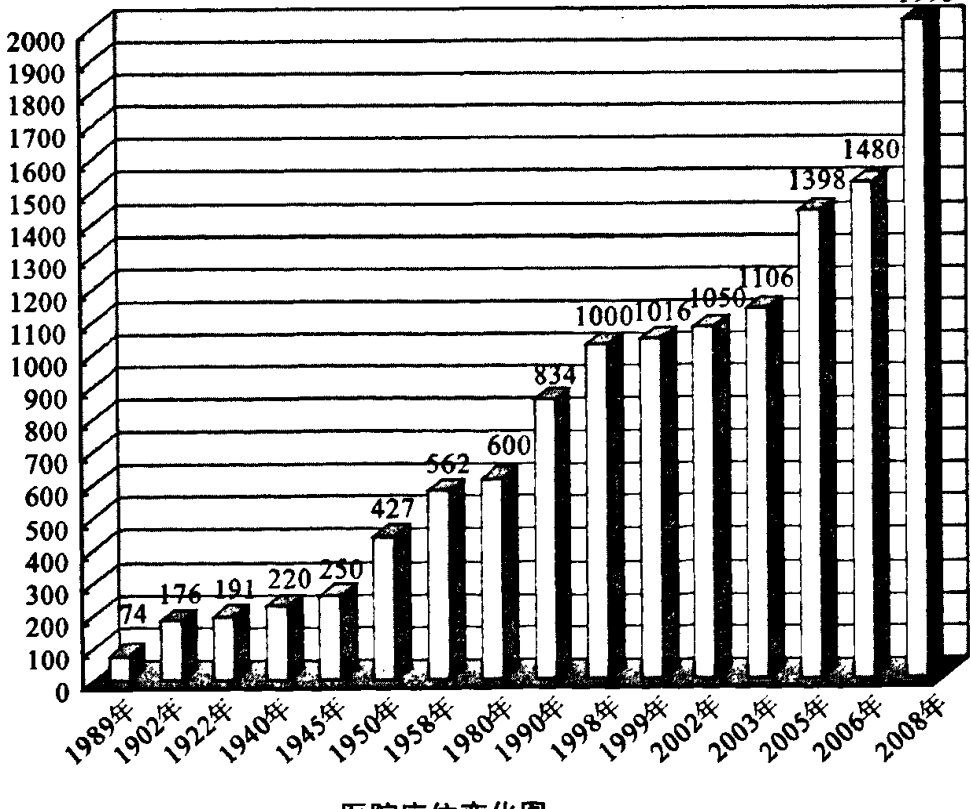
同年,医院开放床位1400张,职工1940人,总建筑面积16万平方米,门诊 126 万人次,住院床日实际占用44万,住院手术1.5万例,出院者平均住院日11.7天,床位使用率101.9%,床位周转率达0.8次,设备总值4.5亿元,万元以上设备1376台件,总收入 6. 7亿元,资产总额11.12亿元,集团总收入9.3亿元。专业学科42个,医技科室20个,研究
绪言 历史沧桑一百一十年室所18个,现代化洁净手术室35间,ICU、CCU、NICU病床60多张。上苑医院实现业务收入2220 万元,较上年增加537万元,收支节余247万元,莒县医院实现业务收入1.03亿元,较上年增长11%,脑科医院实现业务收入5000万元,海阳分院实现业务收入5775万元。
同年,按照青岛大学党委的统一部署,医院认真开展了保持共产党员先进性教育活动。医院各级党组织思想重视,部署周密,把关严格,措施得力,认真组织学习动员,积极开展分析评议,切实进行整改提高,广大党员热情饱满,未学先改,边学边改,参学率达100%。医院研究制定了保持共产党员先进性具体要求,将先进性教育活动与改革创新相结合,与医院管理年活动相结合,与构建和谐医院相结合,积极开展了“立党为公、行医为民,三百爱心工程”,送医疗进社区、义诊、献血等一系列主题实践活动。“三百爱心工程”是由医院出资三百万元在全省范围内捐助100名贫困先天性心脏病患儿、100名贫困唇腭裂患儿、100名贫困白血病患儿。活动开展之初,医院干部职工自发捐款13万元,引起社会各界的强烈反响并激发了全社会的爱心热潮。在先进性教育活动中,医院全体干部职工扎实的工作和突出的成绩赢得了各级党委的充分认可和人民群众的广泛赞誉,中央电视台专题报道了医院的先进事迹,医院历史上第一次走进央视《新闻联播》。人民日报、光明日报、经济日报、青岛日报、半岛都市报、山东电视台、江苏卫视、青岛电视台、青岛经济广播电台等10余家新闻媒体也先后进行了百余次报道。期间,市委先进性教育活动办公室检查组 省委高校工委、大学党委先进性教育活动督导组先后来我校检查指导,对医院的先进性教育活动给予了充分肯定。
同年,小儿科博士点申报成功,医院硕士、博士授予点33个,博士、硕士研究生导师200多名。拥有博士学位人员近200名,归国留学人员近百名,3人担任中华级杂志常务编委,14人担任编委,280人在各级医学会及专业分会中任职。医院高级专业技术人员增长到 457名。在中层干部竞争上岗中,64人分别走上部门领导岗位,医院管理队伍日趋年轻化、知识化和专业化。
同年,医院 PACS系统的开发与应用进一步完善了 HIS系统。目前,由20多台服务器,600多个工作站,40多个子系统组成的医院局域网络,实现了医疗收费管理、成本核算、病人信息、物流、办公自动化、PACS、RIS等的网上运行,数字化医院管理又上新台阶。
全省卫生财务及信息化现场会在医院成功召开,医院财务管理和信息化建设工作得到省厅领导和同行的好评。共有1000多人次来院参观学习。
同年,医院荣获了“全国百姓放心示范医院”、“山东省卫生信访工作先进集体”、“青岛市卫生系统文明单位”、“青岛市卫生防病工作先进单位”、“青岛市医学检验控制先进集体”等一系列荣誉称号。
2006年医院自筹资金,将占地105亩、床位515张的青岛万杰医院收购成功,成立附属医院东区,使医院总床位数达到1936张,医院的事业又迈出了新的步伐。同年,医院完成门急诊133万人次,较上年同比增长5.2%,集团完成门急诊169万人次;医院年出院3.7人次,较上年同比增长2.2%,集团年出院8.1万人次;医院完成手术1.9万例,较上年同比增长5.4%,集团完成手术2.9万例;医院住院实际占用床日46万,较上年同比增长3.6%;出院者平均住院日12天,床位使用率达97.6%。
同年医院人均医疗业务收入达35.7万元,比2005年增长5.5%。医院全年总收入达
跨越百年——青岛大学医学院附属医院志(1898—2008)7.8亿元,较上年同比增长15%,资产总额达16亿元。集团全年总收入达10.3亿元,总资产达21 亿元。
同年,医院加大了设备投入,价值8396万元的一流的高精尖设施充实到临床一线。
以HIS、PACS、LIS为主导的、国内领先的高效信息系统不断完善,东区与医院本部信息实现互通互联,大大提升了各项工作的质量和效率。
同年,医院开展心脑血管、肿瘤等介入诊疗手术3000余例,开展冠状动脉搭桥术170余例,完成肝移植10例、同种异体和自体肾移植42例,疑难危重病例会诊500余次。“急危重症抢救、疑难危重病会诊、腔镜微创技术、介入诊断和治疗、器官移植、干细胞诊断和治疗、基因诊断和治疗”等高新医疗技术的大量开展,有力提升了医院的综合实力和技术水平。
同年,医院以优化专业技术人员结构为导向,组织完成了1672名专业技术人员职务任职资格评审和聘任工作,完成了职能部门管理干部的竞聘工作,95名科级干部通过竞聘走上管理岗位。与此同时,医院积极探索劳动、技术、管理、责任等生产要素参与分配的有效途径,进一步深化分配制度改革,“以岗定薪薪随岗变、多劳多得,绩优薪优”的薪酬分配体系和方案的不断完善,进一步激发了广大干部职工的创业激情。重实绩、出实效的氛围在全院蔚然成风。
同年,医院进一步加大了硬件建设的步伐,代表国内先进水平的外科病房大楼、国内一流的数字化图书馆、现代化的继续教育与临床技能培训中心相继投入使用。内科病房大楼按照现代化建设的要求完成了高标准的装修改造,高水平科技大楼的规划方案已经完成。院区改造和硬件建设水平的大幅度提升,极大地改善了住院环境和工作条件,为高质量的医疗服务提供了有力保障同年,医院通过完善科技创新激励机制,科研工作不断取得新突破。医院成功举办了第八届科教大会暨第六届科技节,全年共发表论文650余篇,其中中华级论文90余篇,被SCI、CA、BA、Medline等收录论文30余篇;主编专著13部;鉴定课题45项,其中17项鉴定课题达国际领先水平;获批专利4项;新立项课题31项,其中国家自然科学基金课题3项、省部级课题27项。荣获省科技奖5项,省软科学奖3项,厅市科技奖23项。医院现有国家级、省级、市级各类专业委员会主任、副主任委员共141人。2位专家卫生部评选为“突出贡献中青年专家”,1位专家被批准享受国务院政府特殊津贴,7位专家成功入选山东省“1020”人才工程。2006年,内分泌科成功申报青岛市重点实验室,儿科、眼科成为省教育厅重点学科,脑病研究所、口腔科成为省教育厅重点实验室。临床药理基地顺利迎接了国家食品药品监督管理局的资格认证检查。省市重点学科和特色专业达到21个,学科建设提高到了一个新水平。
医院肩负着医学院本科生、硕士生、博士生的临床教学和实习工作。在学校党委的正确领导下,医院 2006年的教学评估工作认真贯彻落实“以评促建、以评促管,以评促改、评建结合、重在建设”的20字方针,成立了本科教学评估领导小组和工作组,与各教研室及科室主任签订了《评建工作责任书》,先后出台了《迎接教育部本科教学工作水平评估工作实施意见》《多媒体辅助教学基本规范》等本科教学及评建相关文件。各临床教研室进一步强化了责任意识,较好地完成了教学管理文件汇编、教研室发展规划、工作总结与计划汇编等工作。办公及教学设施的建设,大大改善了各临床教研室工作和教学条件,临床教师队伍的教学积极性进一步提升,形成了团结一心、人人参与、积极迎评的良好氛围。医
绪言历史沧桑一百一十年院临床教学工作在学校及医学院数次教学检查中得到一致好评。教育部专家组对医院临床教学工作及学生临床技能掌握情况给予了高度评价。这些工作成绩的取得为医院及学校赢得了荣誉。一年来,医院圆满完成了本科四年级4800学时的教学任务和五年级 210名学生的实习任务;完成了148名博士、硕士研究生临床学习阶段的培养任务;完成了48项国家级、省级继教项目;圆满完成了436名进修医师、社会化住院医师的培养及科主任、护士长培训;外派医护人员进修培训 75人次。教学意识的不断增强,师资队伍的不断优化,教学条件的不断改善,为进一步提高教学质量和水平,巩固医院人才培养的中心地位打下了很好的基础。
同年,医院高标准设计和建立了继续教育与临床技能培训中心,进一步加强了对各级各类专业技术人员的基本技能培训。医院迎接了卫生部医院管理活动督导组检查,召开了全面医疗质量大会,出台了一系列便民措施,门急诊、住院、手术等业务科室的医疗流程得到了进一步优化,进一步提升了医院的医疗服务和管理水平。
同年,为进一步拓展学科建设与发展的空间,医院积极加强了国内外学术交流与合作。组织医护人员外出参加学术交流活动和外宾来访240余人次。组织3个考察团分别赴美国、日本、韩国、德国等考察交流,与国际知名医院签订了人才培养和学术交流合作协议,目前已有多名中青年骨干到国外培养和深造。医院建立了国际水准的中美干细胞与再生医学中心,聘请诺贝尔医学奖获得者 Murad教授担任客座教授并亲自指导中心的工作,配置了激光共聚焦显微镜、流式细胞仪、干细胞分离机等国际先进的科研设备,为实现科技创新工作的新突破打下了坚实的基础。同时,医院还积极邀请多位国际知名教授来院访问讲学。成功组织专家团赴韩国延世大学举办中韩外科论坛,通过“走出去,请进来”,不断加强学术交流,搭建起高层次的学术交流平台。在“高水平科技创新”目标的指引下,全院上下“重人才、重技术、重学术”的氛围更加浓厚。
同年,医院在青岛市率先推出了“惠民医疗”服务,并接诊患者7000人次,并扎实推进了“立党为公,行医为民,三百爱心工程”。这些惠民工作的开展赢得了社会各界的广泛赞誉,很好地树立了百年老院的良好形象。
同年,医院门急诊达155万人次,住院床日实际占用62万,出院达5.2万人次,住院手术达2.2万例,医院总收入达10亿元,资产总额达20亿元。
2007年1月27日,占地105亩、床位515张、技术力量雄厚的医院东区顺利开诊,这是医院发展史上具有里程碑意义的一件大事。开诊以来,东区发展日新月异,各项工作成绩显著,势头良好。同年,集团各医院发展迅速,成果喜人,集团总床位已达3000张,总收入达13 亿元。
2007年11月,青医附院西区隆重奠基,事业发展迈开了新的更大的步伐。
同年,按照更加细化的岗位设置和评审条件,200余名专业技术人员晋升高一级专业技术职务。至此,医院高级专业技术人员达到557名,博士达到200余名,首席及终身医学专家近50名,各级津贴获得者、拔尖人才、归国留学人员达百余名,国家、省、市重点学科和特色专业 22个,博士、硕士授予点25个,眼科学成为青岛大学历史上首个国家重点学科,临床一级学科获批博士后流动站。代表国内先进水平的外科病房大楼、国际先进的38间标准层流手术间及配置规范、设施先进的ICU病房、供应室提供了良好的硬件支持,国际一流的MM50电子回旋加速器、核磁共振、64层螺旋CT、高能直线加速器等一系列高• 13 •精尖医疗设备总值近7亿元,万元以上设备达3000台件。人才战略高地的构筑和硬件建设的大幅度提升,为开展高水平医教研工作提供了强有力的保证。2007年,医院开展心脑血管、肿瘤等介入诊疗手术3000余例,开展冠状动脉搭桥术150余例,完成肝移植7例、同种异体和自体肾移植32例。医院迎接了卫生部医院管理活动检查,并取得了优异成绩,召开了全面医疗质量大会,通过查摆问题和整改不足,医疗服务质量全面提升。通过不断完善服务窗口弹性工作制、电子化一日清单、康馨电话回访服务等措施,进一步优化服务流程,加强医患沟通,建立和谐医患关系,努力构建社会主义和谐医院。2007年,全院共发表论文800余篇,主编专著7部,鉴定课题2项,获批专利5项,新立项课题 119项,获得科研经费410余万元。其中14项鉴定课题达国际领先水平,新立项国家自然科学基金课题5项、省自然科学基金课题11项,省博士基金课题1项、省软科学研究课题1项,承担科技部和卫生部横向课题9项,国家级纵向课题、国家高层次横向课题创历史新高,SCI、CA、BA、Medline等收录论文40余篇。1名专家荣膺山东省“有突出贡献中青年专家”称号,3名专家成功入选山东省“1020”人才工程。中美干细胞和再生医学中心的临床及研究工作取得初步成果。医院派出外事代表团赴德国、韩国考察交流,积极拓宽人才培养与学术交流的渠道,组织医护人员外出学习交流 360余人次。2007年,在教育部本科教学评估工作取得优异成绩的基础上,医院充分利用国内一流的数字化图书馆、医院文化展厅、设施完备的继续教育与临床技能培训中心,大力加强教学管理和师资力量建设,医院教学水平再上新台阶。
同年,医院应邀在省卫生厅党组理论学习中心组读书会上作了“关于医院运行机制改革”的经验交流,在卫生部召开的全国卫生人才工作会议上作了“关于医院人事制度改革”的典型发言。
2008年,医院本部占地6万平方米,东区占地7万平方米,总建筑面积达20万平方米,资产总额达20.6亿元,开放总床位1995张,职工2600余人,其中高级专业技术人员600余名、博士 240余名、硕士500余名、留学归国人员近百名,国家、省市各级各类专业委员会主委、副主委,卫生部有突出贡献中青年专家,享受政府特贴专家,山东省“1020”人才工程等专家近200名。医院年门急诊量157万人次、出院5.3万人次,手术2.3万例,医院设有临床科室67个、医技科室27个、研究室(所)16个,拥有全国重点学科、省市重点学科和特色专业 23 个,2/3以上学科达国内先进水平。拥有造型别致,功能齐全、代表国内先进水平的外科病房大楼、内科病房大楼、门诊大楼、特需保健病房、国内一流的数字化图书馆和现代化的继续教育与临床技能培训中心,拥有现代化层流手术室38间、MM50电子回旋加速器、1.5T核磁共振、双探头ECT、64层螺旋CT、平板DSA、DR系统、高能直线加速器、激光共聚焦显微镜、基因分析仪、各种现代化检验设备等国际一流的高精尖设备,设备总值达7.2亿元,其中万元以上设备3600台(件),为高水平临床诊断和治疗提供了有力保证。以 HIS、PACS、LIS为主导的高效信息系统,构筑了国内领先的数字化医院建设平台,为高效率的医疗服务提供了保障。急危重症抢救、腔镜微创技术、介入诊断和治疗、器官移植、干细胞诊断与治疗、医药生物技术诊断与治疗等高新技术的大量开展,实现了医疗技术与世界前沿的接轨,为人民群众提供了良好的医疗服务条件。目前,医院正向着“数字化医院管理,人性化医疗流程,高水平科技创新,低成本高效经营”一流现代化医院的宏伟建设目标迈进。
• 14 •
绪言 历史沧桑一百一十年
医院历史沿革表
| 时期 | 年月 | 名称 | 隶属关系 |
|---|---|---|---|
| 德国侵占时期 | 1898.10~1900 | 德国海军野战医院 | 德国海军远东舰队 |
| 1900~1914.11 | 胶澳督署医院 | 大德胶澳督署 | |
| 日本侵占和北洋、国民政府时期 | 1914.11~1916.6 | 陆军病院 | 日本守备军军医部 |
| 1916.6~1927 | 青岛病院 | 民政部 | |
| 1927~1937.6 | 同仁会青岛医院 | 日本同仁会 | |
| 国民政府时期 | 1937.6~1946.2 | 同仁会青岛医院诊疗班 | 日本同仁会 |
| 国民政府时期 | 1946.2~1949.6 | 国立山东大学附属医院 | 南京国民政府教育部、国立山东大学 |
| 青岛解放及新中国成立后至今 | 1949.6~1956.9 | 山东大学医学院附设医院 | 华东军政(行政)委员会卫生部、山东大学 |
| 1956.9~1966.9 | 青岛医学院附属医院 | 山东省卫生厅、青岛医学院 | |
| 1966.9~1972.7 | 青岛白求恩医院 | ||
| 1972.7~1993.5 | 青岛医学院附属医院 | 山东省卫生厅、青岛医学院 | |
| 1993.5至今 | 青岛大学医学院附属医院 | 山东省卫生厅、青岛大学医学院 |
注:附设机构 1958.8~1959.11 青岛医学院附属医院护士学校;1974.9~1993.12 青岛医学院附属医院护士学校;1993.12~2001.7 青岛大学医学院附属医院护士学校;2004.11.29至今 青岛大学医学院附属医院海阳分院;2006.11.16至今 青岛大学医学院附属医院东区。
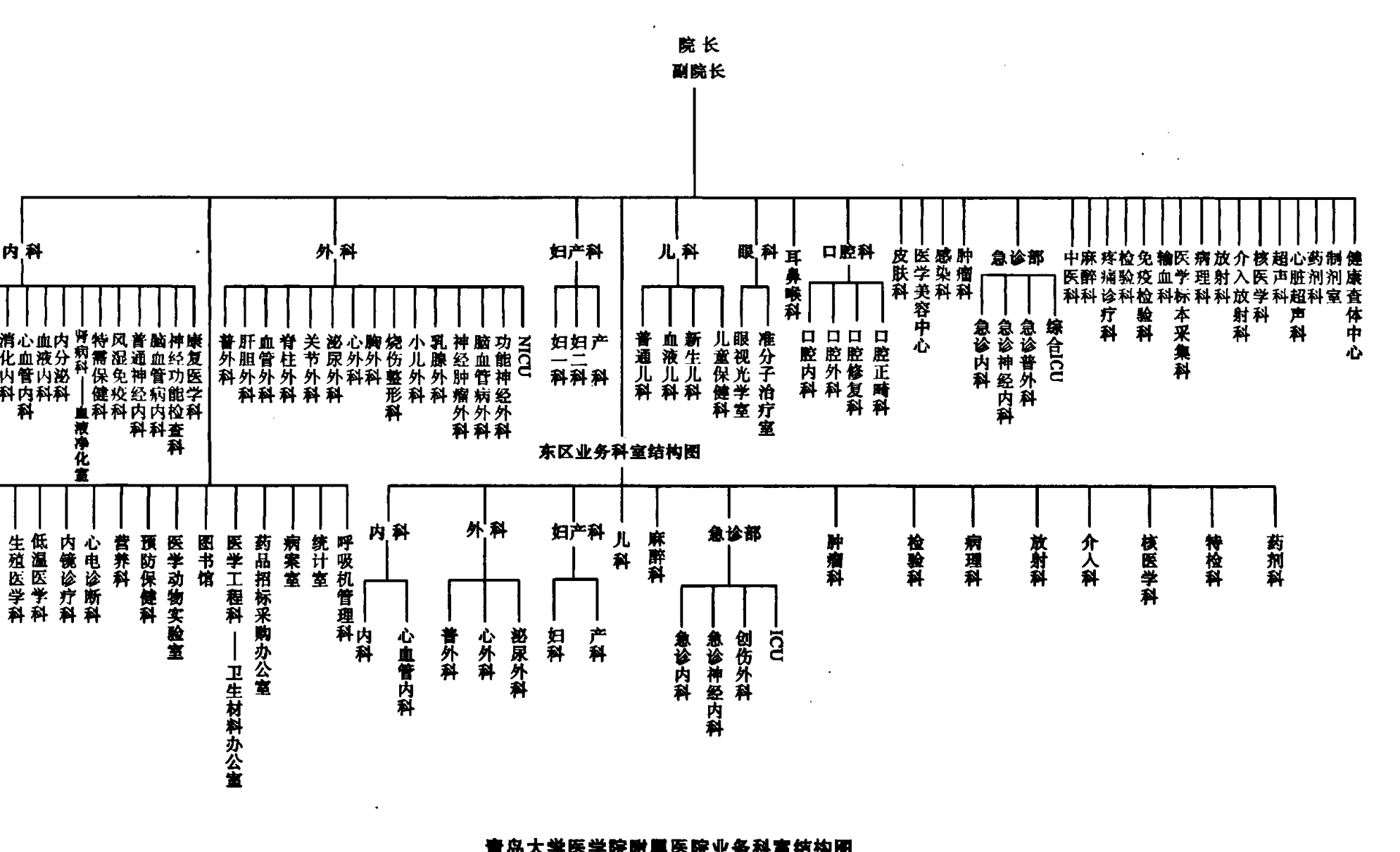
院长 副院长
东区业务科室结构图
- 内科
- 呼吸内科
- 消化内科
- 心血管内科
- 血液内科
- 肾病科
- 内分泌科
- 血液净化室
- 特需保健科
- 风湿免疫科
- 普通神经内科
- 脑血管病内科
- 神经功能检查科
- 康复医学科
- 外科
- 普外科
- 肝胆外科
- 血管外科
- 脊柱外科
- 关节外科
- 泌尿外科
- 心外科
- 胸外科
- 小儿外科
- 神经肿瘤外科
- 脑血管病外科
- 功能神经外科
- 妇产科
- NICU
- 妇一科
- 妇二科
- 产科
- 儿科
- 普通儿科
- 新生儿科
- 儿童保健科
- 眼视光学室
- 准分子治疗室
- 眼科
- 耳鼻喉科
- 口腔科
- 口腔内科
- 口腔修复科
- 口腔美容科
- 口腔正畸科
- 医学美容中心
- 皮肤科
- 感染科
- 肿瘤科
- 急诊部
- 综合ICU
- 急诊普外科
- 急诊神经内科
- 急诊内科
- 中医科
- 麻醉科
- 疼痛诊疗科
- 检验科
- 免疫检验科
- 输血科
- 医学标本采集科
- 病理科
- 放射科
- 介入放射科
- 核医学科
- 介入射疗科
- 超声科
- 心脏超声科
- 药物制剂室
- 药剂科
- 健康查体中心
- 内科
- 呼吸内科
- 心血管内科
- 外科
- 普外科
- 心外科
- 泌尿外科
- 妇产科
- 妇科
- 产科
- 儿科
- 麻醉科
- 急诊部
- 急诊内科
- 急诊神经内科
- 创伤外科
- ICU
- 肿瘤科
- 病理科
- 检验科
- 放射科
- 介入科
- 核医学科
- 特检科
- 药剂科
- 药品招标采购办公室
- 医学工程科 —— 卫生材料科办公室
- 图书馆
- 医学动物实验室
- 预防保健科
- 营养外科
- 心电诊断科
- 内镜诊疗科
- 低温医学科
- 生殖医学科
- 高压氧科
绪言 历史沧桑一百一十年
医院历任行政负责人
| 时期 | 姓名 | 性别 | 籍贯 | 职务 | 分工 | 任职时间 |
|---|---|---|---|---|---|---|
| 德时占期 | 马尔梯姆 | 男 | 德国 | 负责人 | 1898. 4~1900 | |
| 弗斯 | 男 | 德国 | 院长 | 1900~1914 | ||
| 日占时期 | 我妻孝助之 | 男 | 日本 | 院长 | 1914~1916 | |
| 田岛清十郎 | 男 | 日本 | 院长 | 1916~1917 | ||
| 村山有 | 男 | 日本 | 代理院长 | 1917~1918 | ||
| 田岛清十郎 | 男 | 日本 | 代理院长 | 1918~1920 | ||
| 长野文治 | 男 | 日本 | 代理院长 | 1920~1922 | ||
| 铃木又 | 男 | 日本 | 副院长院长 | 1922~1927 | ||
| 栗本定治郎 | 男 | 日本 | 院长班长 | 1928~1944 | ||
| 田中朝三 | 男 | 日本 | 兼班长 | 1944~1945. 8 | ||
| 尾河顺太郎 | 男 | 日本 | 副班长 | 1944~1945 | ||
| 国民政府时期 | 王斐先 | 男 | 中国 | 负责人 | 1945. 11~1946 | |
| 依克伦 | 男 | 中国 | 院长 | 1946. 3~1946. 7 | ||
| 綦建鉴 | 男 | 中国 | 副院长 | 1946. 8~1947. 3 | ||
| 李士伟 | 男 | 河南 | 兼院长 | 1947. 3~1949. 2 | ||
| 潘作新 | 男 | 山东省掖县 | 代院长 | 1949. 3~1949. 6 | ||
| 青岛解放及新中国成立后 | 王滋才 | 男 | 山东省招远县 | 首席军代表 | 全面工作 | 1949. 6~1951. 5 |
| 潘作新 | 男 | 山东省掖县 | 院长 | 医护 | 1949. 6~1951. 5 | |
| 沈福彭 | 男 | 江苏省苏州市 | 院长 | 医护 | 1951. 6~1957. 9 | |
| 王滋才 | 男 | 山东省招远县 | 副院长 | 行政、业务 | 1951. 5~1965. 7 | |
| 林纯之 | 男 | 山东省福山县 | 副院长 | 行政 | 1956. 9~1960. 5 | |
| 张立文 | 男 | 河北省蠡县 | 院长 | 全面 | 1958. 2~1959. 2 | |
| 马瑞珍 | 男 | 山东省临朐县 | 副院长 | 业务 | 1960. 5~1974. 7 | |
| 杜玉环 | 男 | 山东省枣庄市 | 副院长 | 后勤 | 1960. 8~1965. 7 | |
| 刘华甫 | 男 | 山东省沂南县 | 院长 | 全面 | 1965. 7~1967. 1 | |
| 张立仁 | 男 | 山东省寿光县 | 副院长 | 后勤、门诊 | 1965. 8~1983 | |
| 陈树学 | 男 | 辽宁省 | 革委会主任 | 全面 | 1969. 6~1971 | |
| 王培政 | 男 | 山东省 | 副主任 | 政治 | 1970~1971 | |
| 刘华甫 | 男 | 山东省沂南县 | 副主任 | 门诊、后勤 | 1970~1975 | |
| 陈乐山 | 男 | 山东省临沂市 | 副主任 | 政工 | 1970~1975. 1 | |
| 王学颜 | 男 | 山东省 | 革委会主任 | 全面 | 1971~1973 | |
| 刘坤 | 男 | 浙江省 | 副主任 | 政工 | 1971~1972 |
跨越百年——青岛大学医学院附属医院志(1898—2008)
(续表)
| 时期 | 姓名 | 性别 | 籍贯 | 职务 | 分工 | 任职时间 |
|---|---|---|---|---|---|---|
| 青岛解放及新中国成立后 | 刘华甫 | 男 | 山东省沂南县 | 革委会主任 院长 | 全面 | 1975. 1〜1985. 1 |
| 孙忠民 | 男 | 山东省莒县 | 副主任 | 业务 | 1975. 9〜1978. 7 | |
| 袁郁文 | 女 | 山东省青岛市 | 副主任 | 政工 | 1975. 9〜1979. 5 | |
| 王滋才 | 男 | 山东省招远县 | 副院长 | 后勤 | 1978. 8〜1983. 12 | |
| 张立仁 | 男 | 山东省寿光县 | 副院长 | 门诊 | 1978. 8〜1983. 12 | |
| 仲敏 | 女 | 山东省龙口市 | 副院长 | 政工 | 1979〜1983. 12 | |
| 张之湘 | 男 | 山东省安丘县 | 副院长 | 业务 | 1979. 1〜1981. 4 | |
| 栾恒恭 | 男 | 山东省海阳县 | 副院长 | 业务 | 1981. 5〜1989. 12 | |
| 高绪孟 | 男 | 山东省济南市 | 副院长 | 门诊 | 1981. 5〜1985. 1 | |
| 尚秉维 | 男 | 山东省龙口市 | 副院长 | 人事、财务 | 1981. 5〜1989. 12 | |
| 戚天昌 | 男 | 山东省威海市 | 副院长 | 教学 | 1981. 1〜1985. 1 | |
| 高绪孟 | 男 | 山东省济南市 | 院长 | 全面 | 1985. 1〜1997. 3 | |
| 翁维权 | 男 | 福建省 | 副院长 | 医疗 | 1985. 1〜1991 | |
| 解学孔 | 男 | 山东省武城县 | 副院长 | 科研、人事 | 1985. 1〜1987. 1 | |
| 王家勤 | 男 | 山东省沂南县 | 副院长 | 后勤、基建 | 1985. 1〜1991 | |
| 邹存玮 | 男 | 山东省威海市 | 副院长 | 行政 | 1985. 7〜1987. 10 | |
| 乐兴祥 | 男 | 浙江省镇海县 | 副院长 | 教学 | 1985. 1〜1995. 7 | |
| 李悦珍 | 男 | 山东省 | 代院长 | 全面 | 1986. 8〜1987. 2 | |
| 胡有谷 | 男 | 上海市 | 副院长 | 科研 | 1987. 1〜1996. 3 | |
| 苗志敏 | 男 | 山东省淄博市 | 副院长 | 人事、财务 | 1989. 1〜1998. 3 | |
| 杨金镛 | 男 | 山东省招远县 | 院长助理 | 业务 | 1991. 1〜1991. 12 | |
| 国世忠 | 男 | 山东省淄博市 | 院长助理 副院长 | 后勤、基建 | 1991. 1〜1997. 3 | |
| 金志勤 | 男 | 山东省文登市 | 副院长 | 医疗 | 1993. 3〜1997. 7 | |
| 夏青忱 | 女 | 辽宁省黑山县 | 院长助理 | 医疗 | 1993. 3〜1995. 1 | |
| 王淑香 | 女 | 山东省即墨市 | 院长助理 | 护理 | 1993. 3〜1995. 1 | |
| 谷仁凯 | 男 | 山东省威海市 | 副院长 | 教学 | 1995. 8〜1997. 3 | |
| 谷仁凯 | 男 | 山东省威海市 | 院长 | 全面 | 1997. 3〜1998. 3 | |
| 苗志敏 | 男 | 山东省淄博市 | 院长 | 全面 | 1998. 3〜 | |
| 杨松凯 | 男 | 山东省济阳县 | 副院长 | 医疗、护理 | 1996. 1〜 |
绪言 历史沧桑一百一十年
(续表)
| 时期 | 姓名 | 性别 | 籍贯 | 职务 | 分工 | 任职时间 |
|---|---|---|---|---|---|---|
| 青岛解放及新中国成立后 | 董蒨 | 男 | 山东省蓬莱市 | 院长助理 副院长 | 科研、教育 | 1996~1998 1997.3~ |
| 王家勤 | 男 | 山东省沂南县 | 副院长 | 后勤、基建 | 1997.8~2007 | |
| 胡义瑛 | 男 | 山东省青岛市 | 副院长 | 门诊、外事 | 1997.8~2000.3 | |
| 王新生 | 男 | 山东省青岛市 | 院长助理 副院长 | 门诊、医疗 | 1999.1~2002.4 2002.4~ | |
| 赵世华 | 男 | 山东省青州人 | 院长助理 副院长 | 后勤、基建 | 1999.1~2002.4 2002.4~ | |
| 孙运波 | 男 | 山东省莒南人 | 院长助理 副院长 | 门急诊、住院、医保 | 2005.8~2007.1 2007.1~ | |
| 梁军 | 男 | 山东曲阜人 | 副院长 | 东区业务、急诊及医保 | 2007.1~ | |
| 李玉明 | 男 | 山东潍坊人 | 院长助理 | 人事、工会 | 2006.4~ | |
| 李延年 | 男 | 山东海阳人 | 院长助理 | 后勤工作 后勤服务总公司 | 2006.4~ |
青岛解放及新中国成立以来历任院党组织负责人
| 姓名 | 性别 | 籍贯 | 职务 | 任职时间 |
|---|---|---|---|---|
| 王乐三 | 男 | 山东省莱州市 | 党小组负责人 | 1949.6~1949.10 |
| 李吉元 | 男 | 山东省淄博市 | 党支部书记 | 1949.10~1951.5 |
| 王雄 | 男 | 江苏省涟水 | 党支部书记 | 1951.5~1953.12 |
| 王滋才 | 男 | 山东省招远市 | 党支部书记 | 1953.12~1956.6 |
| 糜白辰 | 男 | 安徽省 | 党支部副书记 | 1953.12~1956.9 |
| 聂仲远 | 男 | 山东省 | 党支部副书记 | 1953.12~1956.9 |
| 林纯之 | 男 | 山东省乳山市 | 党总支书记 | 1956.9~1965.7 |
| 季永祥 | 男 | 江苏省连云港 | 党总支副书记 | 1956.9~1965.7 |
| 张立文 | 男 | 河北省蠡县 | 党总支书记 | 1958.7~1958.12 |
| 韩剑修 | 男 | 山东省沂南县 | 党委书记 | 1965.7~1965.12 |
| 孙忠民 | 男 | 山东省莒县 | 党委副书记 | 1965.7~1976.9 |
| 陈乐山 | 男 | 山东省临沂市 | 党委书记 | 1965.12~1973.4 |
| 王学颜 | 男 | 山东省 | 党的核心领导小组组长 | 1973.4~1975.9 |
| 陈乐山 | 男 | 山东省临沂市 | 党的核心领导副组长 | 1973.4~1979.6 |
跨越百年——青岛大学医学院附属医院志(1898—2008)
(续表)
| 姓名 | 性别 | 籍贯 | 职务 | 任职时间 |
|---|---|---|---|---|
| 刘华甫 | 男 | 山东省沂南县 | 党的核心领导小组副组长、组长 | 1973.4~1975.9 1975.9~1979.5 |
| 孙忠民 | 男 | 山东省莒县 | 党的核心领导小组副组长 党委副书记 | 1975.9~1979.5 |
| 袁郁文 | 女 | 山东省青岛市 | 党的核心领导小组副组长 | 1975.9~1979.5 |
| 刘华甫 | 男 | 山东省沂南县 | 党委书记 | 1979.5~1985.1 |
| 仲敏 | 女 | 山东省龙口市 | 党委副书记 | 1979.5~1984.1 |
| 于新江 | 男 | 山东省文登市 | 党委副书记 | 1981.9~1985.1 |
| 李冰清 | 男 | 山东省茌平县 | 党委代书记 | 1985.1~1985.10 |
| 王玉翠 | 女 | 山东省荣成市 | 党委副书记 | 1985.1~1988.7 |
| 邹存玮 | 男 | 山东省威海市 | 党委副书记、书记 | 1985.7~1988.7 |
| 门相宦 | 男 | 山东省高密县 | 党委副书记、书记 | 1987.10~1991 |
| 苗志敏 | 男 | 山东省淄博市 | 党委副书记 | 1988.7~ |
| 谢德新 | 男 | 山东省文登市 | 党委书记 | 1991.6~1994.10 |
| 宋钦和 | 男 | 山东省乳山市 | 党委副书记 | 1991.5~1997.3 |
| 高绪孟 | 男 | 山东省济南市 | 党委书记(兼) | 1994.10~1997.3 |
| 王大文 | 男 | 山东省临朐县 | 党委书记 | 1997.3~2007.8 |
| 崔华青 | 男 | 山东省栖霞县 | 党委副书记 | 1997.3~2006.5 |
| 谷仁凯 | 男 | 山东省威海市 | 党委副书记 | 1997.3~1998.3 |
| 王新生 | 男 | 山东省青岛市 | 党委副书记 | 2006.5~ |
| 姜振家 | 男 | 山东省即墨市 | 党委书记 | 2007.8~ |
1967年1月16日~1973年4月为造反派掌权。
PREFACE VICISSITUDESIN ONE HUNDRED AND TEN YEARSAncient medicine relies focally on doctors while modern medicine relies focal-ly on hospitals. Well-organized hospitals has only a history of 150 years in China,from the early religious & charity hospitals, the army hospitals after the OpiumWar, to a number of large scale medical college affiliated hospitals appeared at be-ginning of 20 century. Our hospital is a former field hospital established in earlyGerman Occupation Period. Almost the same as Qingdao's evolution, it has a historyof already 110 years.
In the centennial history, the hospital has generally experienced 5 periods of totally51 years, i. e. German Occupation Period (1898-1914), 1st Japanese Occupation-North-ern Warlords Government-Nanjing Kuomintang Government Periods (1915-June 1937),2nd Japanese Occupation Period (July 1937-August 1945) and Nanjing Kuomintang Gov-ernment Period (September 1945-May 1949). The fifth period is after the liberation ofQingdao, totally 59 years from June 1949 to June 2008.
I. German Occupation Period (1898-1914)In November 1897, on the pretext of the Juye church case in Shandong CaozhouCounty, German sent its navy far east fleet to invade Jiao Ao (Jiaozhou Bay). In the ear-ly summer next year (April 1898), 4 German soldiers and many Chinese civilians died ofthe intestinal epidemic, for which the German fleet allocated 9 tents for a field hospital atsouth foot of Guanxiang Hill for mainly treatment of German soldiers. Meanwhile, in or-der to draw the local people's support, the German colonial ruler also opened clinic toQingdao residents. This becomes the earliest hospital in Qingdao and marks the inflow ofwestern medicine to Qingdao.
The tent field hospital was only a temporary emergency ward but not able to settleall the patients. Before long, a large multi-department tent was set up yet still not e-nough. To consolidate its ruling, the German occupier decided to construct a hospital for
跨越百年——青岛大学医学院附属医院志(1898—2008)"convalescence of German soldiers and visitors besides medical treatment of the Germansand the Chinese".
The hospital first phase was constructed in October 1898-October 1899 and put intouse at end of the year. The new hospital was named German Jiao Ao Government Hospi-tal with Prof. Martim as the director. In 1904, Licun Hospital was constructed in thesuburb, which was the earliest branch hospital. The German occupier spent nine yearsfrom 1898 to 1906 and 1.98 million DM to complete the hospital.
The German Memorandum of Health Cause Development in Jiaozhou Area publishedin Berlin in 1910 records the details of the early years of the hospital;
( I ) Year 1898People's health was good in Qingdao's agreeable climate until the start of rainseason, when enteritis cases frequently occurred to the European residents, sol-diers and local people in Qingdao. Later a few dysentery and even malaria cases werefurther found. Four German soldiers died of these diseases. And rheumatic arthritisoccurred from time to time too.
The German navy provided nine tents as ward which also served the local civil-ians. However, the tents were suitable for wards yet not the local climate. There-fore, constructing a new hospital brooked no delay. Construction was going busilyand was expected to put into use before the next rain season. The new army hospitalwould also receive civilian patients for the moment.
The Jiaozhou area still had no special Chinese hospital, yet the German navydoctors had already set up clinic free for Chinese people with paying just a littlefor medicines and materials.
Like every colony during its early stage, the general health situation was notsatisfactory, and there's still serious lack of housing and drinkable water. Withsolving of these problems, the health situation could be gradually improved and wasexpected to approach the level in Germany.
( II ) Year 1898-1899The most urgent was to construct a field hospital because those tents werestill unable to locate all the patients in spite much efforts in installation. Apiece of ideal southward sloping land was chosen between the Governor-General's Of-fice and Signal Hill. The field hospital was to have 156 beds and meet the localpeople's medical demand. To arrange these beds, three two-storey inpatient build-ings and one separated inpatient building would be built. Affiliated buildings
PREFACE VICISSITUDES IN ONE HUNDRED AND TEN YEARSwould include one office building with kitchen, storage and official's dormitory,one pharmacy building with a dressing room, two affiliated buildings with guardsand Chinese worker's dormitory, one laundry with a disinfection room, one garageand mortuary.
Already completed and put-into-use buildings included the separated inpatientbuilding, two guards' dormitory buildings and the pharmacy building. Constructionof one two-storey inpatient building was progressing that completion was foreseenby December 1899. The other two-storey inpatient building, the garage and the laun-dry had been started construction.
For temporary reception of patients, a large tent was put up with everythingready. In addition, a cellar was completed.
Water was supplied from a well through a pressure pipe driven by a motor. Thesewage was drained into the already laid sewage system. The difficulty in construc-tion came from the local sloping land, which needed a large amount of earth works.
( II ) Years 1899-1901The old field hospital was used until the end of 1899 and the new garden-likehospital had been mostly completed and put into use. The first big building (No. 1Building) was completed at the end of the year of this report, with 39 ward beds. Be-sides two large ward rooms of 16 beds, there're 7 private rooms, washing basin,bathing room and cleaning facilities, 1 attending physician's office and somedoctors' dormitories. The hospital also included a house named Naimisen and a laun-dry. A large ward building (No. 2 Building) was started construction at the begin-ning of this year and had been completed now with a floor area 893 m² for up to 35beds. Besides two large wards and three small wards, this building had also specialoperating rooms with affiliated dressing rooms and dressing instrument rooms, oneliving room for assistant doctors and five dormitory rooms for medical workers.
Other ward buildings and houses needed to be accelerated that the hospitalcould receive more patients before the beginning of the winter. Hence, a larger 30-bed ward building (No. 4 Building) on a 664 m² land was constructed and completedready for use. For the moment there're still a medical worker's dinning hall and bac-teriological laboratory under construction. The largest ward building (No. 3 Build-ing) not mentioned above yet was designed and ready for construction. This buildingwould include ophthalmology, otology and neurology wards, an X-ray room, dormitoryrooms for a married hospital supervisor and two assistants, a spacious chapel andresidence rooms for medical workers. This building and No. 2 building both had a low-pressure heat boiler. The present development seemed to need to enlarge the sewage
跨越百年——青岛大学医学院附属医院志(1898—2008)network. Motor ways and pedestrian walks were being improved. The hospital dugthree wells temporarily for water supply pumped into a high water tank which thensupplied water to the buildings. When the city water network was in place, the pres-ent water pipes could be connected into the network. When the power plant feed ca-bles passed by the hospital, the buildings and the paths were expected to have elec-tric lighting.
(N) Year 1902The field hospital was generally completed, except for the No. 3 building whichwas to be put into use before long. An additional garden was constructed. The de-signed facilities not yet finished only included the mortuary and the fence.
Four nurses sent by the Colony Patient Nursing Women's Association were busyworking in the field hospital and highly favored.
As to the early disciplines, staff and charge rates, the Jiaozhou Bay publishedin 1913 in Japanese written by Tahara Shinjiro has some scraps of records;
Among Qingdao hospitals, the largest and most well-equipped was the German Gov-ernor-General's Office Hospital, i. e. Navy Hospital, which was situated in the Bis-marck Street at foot of the Observatory Hill enjoying broad view and fresh air. Ithad almost every disciplines like internal medicine, surgery, venereal disease, o-tolaryngology, psychiatry, obstetrics, pediatrics and pulmonary disease as well asseparated wards and separated women's wards. It's designed for only navy and armysoldiers, but opened also to the general public. However, it's said that it got lowreputation due to worse attitude towards the public than the soldiers. The ward andmedicine charge was 7 Yuan for the first class, 5.5 Yuan for the second class and 2.
5 Yuan for the third class. The present staff consisted of the president Firth, doc-tor Uorp, doctor Wintour, doctor Wacher, doctor Ulhillis and doctor Genzken. DoctorMuller, duke Herzburg and pharmacy director Bucevholtz were at the same time the na-vy doctors.
The rates of doctor's fee were defined by a resolution of Qingdao PracticingDoctors Meeting and approved by the Civil Affairs Director on October 16, 1902 asfollows:
3 Yuan at the hospital, 2 Yuan for the less wealthy;
5 Yuan for home visit, 3 Yuan for the less wealthy;
An extra half charge for night service (9 p.m. 7 a. m.);
An extra 1 Yuan per hour for home visit beyond 1 hour;
70 Yuan/person for one-year contracted service, 50 Yuan for the less wealthy;
300 Yuan/family for one-year contracted service, 100 Yuan for the less wealthy;
PREFACE VICISSITUDES IN ONE HUNDRED AND TEN YEARS50 Yuan for baby delivering, 30 Yuan for the less wealthy;
Big operation fee to be defined separately;
25 Yuan/person for one-month contracted service;
5-15 Yuan for certificate of diagnosis.
II. 1st Japanese Occupation-Northern Warlords Government-NanjingKuomintang Government Periods (Nov 1914-June 1937)On November 11, 1914, Japan took the opportunity of World War I to replaceGerman's occupation in Jiao Ao and the hospital was taken by the Japanese invaders asArmy Hospital with the class C army doctor Aduma Matushima as the president. After-wards, two branch hospitals were opened in Jinan and Fangzi.
Since Japan's occupation of Jiao Ao, Japanese army officials and capitalists wereflocking to Jiao Ao for business, resulting in surging Japanese population.
In May 1915, the Japanese occupier set up Qingdao Convalescence Hospital at thepresent No. 19 Jiangsu Road with Aduma Matushima as the president and at the sametime issued Rules of Qingdao Convalescence Hospital.
In March 1916, the Japanese administration modified the Rules and put the hospitalunder jurisdiction of the army commander, with Haibo Clinic, Yeying Clinic and TaixiInfection Disease Clinic for treatment of prostitute's venereal diseases adopted by the con-valescence hospital. In June, Qingdao Convalescence Hospital was renamed QingdaoHospital and moved into the headquarter. To date, the headquarter was divided into twoparts, the northern Army Hospital and the southern Qingdao Hospital.
In April 1917, Licun Clinic was included into Qingdao Hospital as its Licun BranchHospital. The army class C doctor Tajima Seijuro acted as the president of the ArmyHospital in September. In October, the Japan administration changed its nature frommilitary to civil and issued Rules for Civil Hospital. Qingdao Hospital was put under ju-risdiction of the army's civil affairs department with the chief army doctor Murayama asthe hospital's president. Through organization reform, physician recruitment and equip-ment purchase, the hospital scale was enhanced.
In March 1918, Muruyama was moved and the original Army Hospital's presidentTajima Seijiro was designated as the acting president of Qingdao Hospital.
In April 1919, Sifang Hospital situated out of the Sifang Locomotive & RollingStock Works was included into Qingdao Hospital with a name of Sifang Branch Hospital.
In November, a new Puji Hospital was constructed at Jiaozhou Town as a branch.
In May 1920, the Japanese army civil department director and physician NaganoBunji acted as the president of Qingdao Hospital.
In December 1922, Japan was obliged to return Qingdao's sovereignty to the ChineseNorthern Warlords Government yet still reserved a lot of privileges and rights in politics,economy, culture and military, making Qingdao an important base for Japan's China ag-gression. China and Japan had several negotiations about the ownership of Qingdao Hos-pital, but Japan took its huge investment as an excuse to continue its operation with amedical bachelor Suzuki as the hospital's president.
In 1925, Japanese Foreign Affairs Ministry decided that the Colleagues Associationtook over Qingdao Hospital. On March 22, the association sent a director Ono Ichiro toJiao Ao for the take-over formalities with Suzuki as his successor. In March 1927, theColleagues Association Qingdao Hospital was renamed Qingdao Hospital, and medicalbachelor Kurimoto Joriro was designated as the president in the next June.
On April 15, 1929, Nanjing Kuomintang Government took over Jiao Ao and re-named it "Qingdao" with an office set up there. In July, Qingdao Special City was foun-ded, which belonged to the Nanjing Government. Later, Qingdao City Government wasset up to replace the "special city" title the next September. However, in the policy of"resisting foreign aggression after stabilizing the country", the Kuomintang Governmentdidn't negotiate with Japan to take back the hospital which then still belonged to JapanColleagues Association.
II. 2nd Japanese Occupation Period (July 1937-August 1945)On July 7, 1937, Japanese invading force in name of military exercises at BeijingLugouqiao suddenly attacked the local Chinese troop and the Chinese 29th army resistedstrongly, marking the start of Chinese Anti-Japanese War. The Japanese Cabinet formal-ly approved its Qingdao offensive plan on August 20 and organized an invading force. Inthe situation the Qingdao war may break out at any moment, the Chinese army launchedvigorous counterattack against the Japanese invading force, which then sent the army in-tended for Qingdao to Shanghai together with the withdraw of Japan consulate and immi-grants from Qingdao. In September, the Northeast Army took the defense of Qingdaoand helped Qingdao restore the CPC organization with extensive anti-Japanese propagan-da and activities. In late November, in the increasingly urgent situation of Qingdao,Shandong University and key research organizations and enterprises moved westward tothe inland, and a large number of residents left the downtown. On December 27, ShenHonglie leading the city government staff and security corps abandoned Qingdao beforeseeing the Japanese army.
On January 10, 1938, the Japanese invading force occupied Qingdao for the second
PREFACE VICISSITUDES IN ONE HUNDRED AND TEN YEARStime and took the hospital as an army hospital. The Colleagues Association QingdaoHospital was arranged as a war-time medical organization with a new name ColleaguesAssociation Qingdao Hospital Medical Team headed by Kurimoto Joriro with the onlyclinic at present No. 19 Jiangsu Road. Later, a temporary ward with 40 beds was set upat the present No. 43 Jiangsu Road together with two clinics at Taidong and TaixiTowns.
In June 1940, Kurimoto Joriro transferred the Taixi clinic to Qingdao Health Bureauand cancelled the Taidong clinic. In October, the army hospital was moved out and thehospital was gradually restored with more and more business. In November 1941, it wasrenamed Colleagues Association Qingdao Medical Team. In December 1944, KurimotoJoriro left his post with the master of Qingdao Medical School and Japanese navy generalTanaka as his successor.
N. Nanjing Kuomintang Government Period (September 1945-May 1949)On August 15, 1945, Japan as a defeated country unconditionally surrendered. OnNovember 6, Qingdao City Government sent the Education Bureau director Meng Yun-qiao and president of Boji Hospital Chen Zhizao to take over the Colleagues AssociationQingdao Medical Team, with Wang Feixian designated as the director. Most Japanesemedical workers left for Japan with only 9 persons such as Tanaka to continue their du-ties. In January 1946, as decided by the Nanjing Kuomintang Government Education De-partment and Social Department Health Office, the medical team was transferred toShandong University. On March 1, it was renamed the Affiliated Hospital of the Nation-al Shandong University with the physician Yi Kelun as the president. In early 1947, Mr.
Li Shiwei, after taking his office as the president of Shandong University Medical Col-lege, also acted as the president of the affiliated hospital with Yi Kelun being a professorof the Medical College.
As the affiliated hospital of Shandong University Medical College, the hospitalgained enhancement in scale, equipment and technology with 250 beds, 11 departmentslike internal medicine, surgery, Obstetrics and Pediatrics, and a staff of more than 340members. It had gradually established a medical working system like doctor keeping of-fice hours, resident doctor's 24-hour responsibility system, etc. The hospital had succes-sively employed some medical experts of great attainments such as Pan Zuoxin in ophthal-mology, Feng Yanchen, Qi Tianchang and Zhang Zhixiang in surgery, Yang Feng in in-ternal medicine, He Sen in obstetrics, Liang Fulin in otolaryngology and Li Jingyi in der-matology. Key departments gained bigger ability through research of difficult diseasesbesides treatment of common diseases and frequent diseases. The hospital's name started
跨越百年——青岛大学医学院附属医院志(1898—2008)to be popular among people.
In 1946, with support of America, Kiang Kai-shek launched internal wars but wasrepeatedly defeated. In early 1947, he focused on Yan'an and Shandong. Qingdaoshowed severe inflation, inorderness and poverty. The medical workers lived a hard lifeon little salary. The hospital strived to maintain half-day business under hard conditionseven no heating in winter.
1Since September 1948, the People's Liberation Army of China captured Jinan andwon three battles Liaoshen, Huaihai and Pingjin, and Qingdao also saw the hope of lib-eration soon. In February 1949, the hospital president Li Shiwei left for Taiwan throughShanghai by sea. Before leaving, Li entrusted Prof. Pan Zuoxin, the director of depart-ment of ophthalmology, to be the acting president.
V. After Liberation of Qingdao (June 1949-June 2008)The hospital took a new life since the liberation of Qingdao on June 2, 1949. Thenext day, Qingdao Military Control Committee of the China People's Liberation Armysent Wang Zicai and Wang Lesan as representatives to take over the hospital which wasthen renamed the Affiliated Hospital of Medical College Shandong University.
With Wang Zicai as the chief military representative and Pan Zuoxin as the presi-dent, the hospital belonged to East China Military Committee Health Department andShandong University. In March 1951, East China University established by the libera-tion area moved from Jinan to Qingdao as instructed by the Ministry of Education andmerged into a new Shandong University with medical doctor Shen Fupeng as the presi-dent and Wang Zicai as the vice-president. Under wise leadership of Chinese CommunistParty and the People's Government, the hospital took a new look.
In March 1956, Ministry of High Education of the People's Republic of China ap-proved Shandong University Medical College to set up a separate college-Qingdao MedicalCollege. In September 12, as instructed by Shandong Province People's Committee, thehospital was renamed the Affiliated Hospital of Qingdao Medical College as a subordinateof the Province Health Department and Qingdao Medical College. The Culture Revolu-tion starting in 1966 brought a disaster to the hospital whose rights were totally seized bythe Rebel Faction in turmoil. Many officers and technicians were devastated, and thehospital was ever renamed Qingdao Bethune Hospital (September 1966-July 1972). OnOctober 6, 1976, the hospital got into the normal track again. In December 1993, withapproval of the National Education Committee, Qingdao Medical College was merged intoQingdao University and the hospital was accordingly renamed the Affiliated Hospital ofMedical College Qingdao University.
PREFACE VICISSITUDES IN ONE HUNDRED AND TEN YEARSIn the 1950s-1960s, after Shen Fupeng, there had been Lin Chunzhi, Zhang Liwenand Liu Huafu as the president of the hospital, who carefully implemented CPC policies,invited famous Chinese physicians, adopted new members into CPC and overcome variousdifficulties in the progress of the hospital.
After the founding of P. R. C., the country experienced economic restoration, socialrehabilitation and some movements. The medical team trained in political lessons and va-rious practices gradually got the determination to serving the people. Following the CPCguidelines of "people orientation, prevention priority, unified Chinese and Western medi-cines, and engagement between health work and massive movement", various work ofthe hospital actively adapted to the demand of the country and society. In 1951, the hos-pital deployed three Korean War medical teams and anti-bacterial war medical teams (to-tally more than 70 persons) respectively headed by Feng Yanchen, Wang Zicai, ZhangZhixiang, Han Jiyi and Yang Feng. The teams worked hardly and some team membersrepresented by Zhang Chuanjun had won the first achievement prize. Meanwhile, themembers actively made donations to the army. Five members incl. Tian Jiachen joinedmedical work at the frontiers. When the severe earthquake hit Tangshan and Fengnan onJuly 28, 1976, the hospital immediately sent two teams to Tangshan for treatment andtransfer of the wound people. Some members like Zhu Cuizhi, Weng Weiquan and DongGuoying even risked their life to rescue the wound people in mine pits. 132 wounded peo-ple were treated in the hospital. Since the early 1950s, the hospital have sent medicalteams up to 100 members every year to factories and villages for disease treatment,health knowledge training and medical survey in Qingdao, Yantai, Changwei and Linyicities, such as the filariasis medical team to Rizhao in 1958 and the medical teams to oldrevolutionary base areas in 1965 were well favored by the local people. To improve theTibetan region medical conditions, the two medical teams sent to Tibet in 1975 and 1977had provided wholehearted health service for the Tibetan people in hard conditions. Since1954, as required by the Province Health Department, the hospital had successively es-tablished teaching relations with tens of key hospitals in Jiaodong and Changwei areas inways of diagnosis meeting, training, periodic lectures. From the 1950s to 1970s, keymedical members were dispatched to hospitals in Yantai, Changwei, Linyi, Binzhou andShengli Oil Field to enhance the local medical level. Since the middle 1950s, some medi-cal teams were sent to Mongolia, Tanzania and Seychelles to improve these countries'medical conditions and people's health, making a contribution to China's international re-lations.
After the 10-year "culture revolution", everything returned to the right track andthe CPC held the 3rd Plenary Session the 11th Central Committee. The hospital leadersand staff carefully acted the meeting's spirit and policies with an open and innovativemind, and shifting the work focus to medical treatment.
As approved by the higher authorities, Liu Huafu assumed office of president andCPC secretary-general of the hospital in May 1981 with the successors in subsequentyears as follows: Gao Xumeng as president and Li Bingqing as acting secretary-general inJanuary 1985, Zhou Cunwei as secretary-general in July 1985, Men Xianghuan as secre-tary-general in July 1988, Xie Dexin as secretary-general in June 1991, Wang Dawen assecretary-general and Gu Renkai as president in March 1997, Miao Zhimin as president inMarch 1998, and Jiang Zhenjia as secretary-general in August 2007.
In 1985, the hospital had a staff of 1,127 persons, including 790 in medical work (8senior, 118 middle and 664 junior), 74 in administration, 166 in logistics and 97 others.
The hospital treated 554,335 person-times incl. 515, 151 clinic, 24,203 emergency, 1,650 physical examination, 3,826 inoculation, 9,509 in-patient admissions and 9,469 in-patient discharges with cure rate of 61.9%, improve rate of 27.3%, death rate of 3.4%,bed occupancy of 90%, bed turnover rate of 15.8 person-times and average stay of 20.7days. The whole year realized a total revenue of RMB 5,963,648, with RMB 3,283,648from out-patients and RMB 2,680,000 from in-patients.
In 1993, a team from Shandong Province Hospital Rating Committee made a 4-daysite evaluation on the hospital's administrative management, logistics, medical manage-ment, nursing management and infection control, and gave the hospital a basic criteriascore 965.5 points and a rating criteria score 943. 5 points, higher than the criteria for athird-grade class A hospital. Shandong Province Hospital Rating Committee accreditedthe hospital as a third-grade class A hospital, the first of its kind in Qingdao. In March1994, the hospital held a ceremony which was attended by the Province Health Depart-ment director Zhang Qinglin, Qingdao vice-mayor Zhou Diyi and Qingdao Health Bureaudirector Zang Aimin.
In the same year, the hospital showed bed occupancy of 88.9%, bed turnover rate of14.6%, 444,178 person-times of out-patients, 11,939 in-patient admissions, 11,974 in-patient discharges and average stay of 21. 9 days with cure rate of 93%, improve rate of28.2%, death rate of 2.0%, successful out-patient rescue rate of 89.5%, diagnosis ac-curacy of 99.0% and aseptic incision class A healing rate of 99.8%. The hospital had or-ganized totally 402 cross-hospital diagnosis, saved 2,843 person-times of severe patientsand realized a total revenue of RMB 69. 04 million.
'In 1998, the hospital had a staff of 1,507 members, including 1,197 in medical work(48 senior, 135 sub-senior, 347 middle and 667 junior), 70 in administration, 172 in lo-gistics and 68 others. The hospital had 11 staff members with a doctor's degree, 137members with a master's degree and 343 members with a bachelor's degree. The ophthal-mology doctorate conferring base was approved, opening a new page in doctorate educa-tion of Qingdao University.
The hospital bed number was increased to 1,000 and realized the ninth-five-year plan
PREFACE VICISSITUDES IN ONE HUNDRED AND TEN YEARStarget for hospital scales. It received 637,051 person-times of out-patients with a 20%year-on-year increase, 17,612 in-patient admissions with an increase of 1,708 admissionsthan last year, 17,484 in-patient discharges and 7,838 operations with bed occupancy of95%, bed turnover rate of 20. 1% and a total revenue of RMB210 million. The revenue-expenditure ratio was controlled within 96. 47%.
On January 22, 1999, the hospital was conferred by CPC Qingdao City Committeeand Qingdao City Government the title "Year 1998 Model Group in Qingdao Social Secur-ity Comprehensive Control". In February, the hospital's first case of aortic root replace-ment operation with aortic valve kept and rescue coronary angioplasty operation for cu-ring ascending aortic aneurysm and aortic incompetence were successfully made. OnMarch 6, Chinese Medicine Association Qingdao Sub-association Endocrinology Commit-tee inaugural meeting was held in the hospital, electing Miao Zhimin as the chairman. OnMay 26, three staff members of the hospital including Miao Zhimin won Qingdao Scien-tific and Technological Advancement Award.
In March, the hospital was listed by the Province Health Department as one of thefour province-level medical organization reform pilot units.
In October, on the 5th annual meeting of National Ideological Research Associationof Province-level Comprehensive Hospitals, the hospital's CPC committee was awardedthe title "National Advanced Province-level Comprehensive Hospital".
In 2000, by implementing three strategies "Strengthen Talent and Discipline Devel-opment, Enhance Foreign Opening-up and Exchange, and Accelerate Research ReformPace", the hospital got a further development momentum and finished its first step in the"Three Step" reforms.
In the same year, with the employment system as top priority, the hospital contin-ued its personnel reform in posts re-identification, employment of directors for 56 depart-ments, head nurses and administrators, and pilot competitive employment of leaders ofsix teams like the logistic oxygen station. Through competitive employment, the numberof department directors decreased from 125 to 117 with the average age decreased from46. 7 years to 43. 9 years, and the number of persons holding a doctor's or master's de-gree increased from 40 to 49. Some competent young people took leadership offices to in-"creasingly strengthen the director team. In management employment, the number of ad-ministrative officers reduced from 78 to 59 with a 24% shrinkage, 17 officers beingmoved down and 4 incompetent officers being laid off. The proportion of officers aged a-bove 45 was lowered from 68% to 56%, and proportion of college degree increased from43% to 73% while middle qualifications still kept 58%.
Through employment, the posts, ages, degrees and qualification structure were fur-ther optimized. In qualification assessment, 83 persons gained a higher rank and 12 per-sons successfully passed the evaluation of the Province Senior Qualification Assessment
跨越百年——青岛大学医学院附属医院志(1898—2008)Panel.
A "chief medical expert system' was innovatively established by flexibly invitingmore than 30 famous medical academicians and doctoral supervisors like Li Jieshou, FanDaiming, Wang Zhongcheng, Zhang Yun and Xie Lixin. Five targets, i. e. inviting onefamous expert, driving a key discipline, starting a unique department, gaining first-classresearch achievements and training a lot of mainstay talents, were realized, enabling thehospital's excellent talents grow rapidly on shoulders of these experts. By formulatingProvisional Measures for Employing High-level Talents, innovating perfect talent as-sessment system, and providing outstanding remuneration and working conditions, alarge number of domestic and overseas excellent talents were attracted, including 7 ofdoctoral degree and 24 of master degree. Together with 36 persons gaining doctor ormaster degree through on-the-job study, the hospital had totally 35 persons of doctoraldegree, 24 of master degree and 56 of oversea study experience.
In the same year, the hospital convened internal emergent diagnosis of more than500 person-times involved and outside diagnosis of 746 person-times, participated in res-cue in five accidents like Laoshan Mountain fire, Jimo 11 migrant workers poisoning andJune 23 traffic accident, and many times of health care of state leaders. The hospital re-ceived 875,000 person-times of out-patients, 24,700 in-patient discharges and 11,000 op-erations with cure and improve rate of 92.5%, average stay of 14. 1 days, bed occupancyof 100.4%, bed turnover of 25. 3 person-times, out-patient and in-patient diagnosis coin-cide rate of 99.9%, operation before and after diagnosis coincide rate of 99.8%, out-pa-tient cure rate of 95.7% and in-patient cure rate of 83. 1%.
In January 2001, the hospital won the title "Qingdao Model Unit for Spiritual Civili-zation".
In February, the comprehensive research achievement of Chinese pronunciation pa-thology and correction for cleft palate by the stomatology director Prof. Li Ningyi wasapplied by the whole province. The department of ophthalmology achieved encouragingprogress in scientific and clinic research of diabetes retinopathy, with related researchesreaching international leading level and being the first of its kind as evaluated by experts.
In June, a delegation headed by State Health Vice-Minister Wang Longde and De-partment of Medical Administration director Wu Mingjiang, accompanied by the provinceand city's health leaders, visited the hospital to investigate the National Three SystemReform program. President Miao Zhimin briefed the guests on the hospital's situationand the delegation highly appraised the hospital's outstanding work in personnel reform,medicine system reform, discipline development and the practice "selecting doctor by pa-tient", which took the lead in the province or even the country.
In the same year, the hospital was conferred the title “National First Lot of PeopleSatisfactory Hospitals", "Advanced Unit in Qingdao's Strive towards National Model
PREFACE VICISSITUDES IN ONE HUNDRED AND TEN YEARSEnvironment City" and "Qingdao Advanced Group in Patriotic Health Campaign".
In November, Consul General of Japan visited the hospital and issued JapanAmbassador's Prize to the hospital's president Miao Zhimin and vice-president DongQian.
In 2002, through highlighting unique technologies, constructing service network,strengthening department construction and trying merit pay system, the hospital furtherelevated its efficiency and benefits, and finished the second step in the "Three Step" re-forms. The hospital's reached 1,638 members, including 1,343 medical (62 senior, 201sub-senior, 430 middle and 650 junior), 63 administrative, 176 logistics and 65 others.
The hospital had totally 40 doctors, 240 masters and 275 bachelors.
In the same year, the hospital treated 860,000 person-times of out-patients and e-mergent patients with a year-on-year increase of 10%, 30,700 in-patient discharges withan increase of 5.3%, actual bed occupancy of 390,000 bed days, up 5.3%, 14,700 oper-ations, up 11.8%, average stay of 12. 5 days with a decrease of 1. 3 days, bed turnoverof 29. 2 times, bed occupancy rate of 102.4%, out-patient and in-patient discharge diag-nosis coincide rate of 99.8%, clinic and pathological diagnosis coincide rate of 99.2%. Inthe whole year, 1,476 person-times of emergent and severe patients were rescued with asuccess rate of 90%.
In the same year, in principles "human orientation, quality the first, quantitativerating, doctor selection, comprehensive evaluation, merit pay and dynamic manage-ment", the hospital took the national lead in innovatively apply the new pattern "depart-ment comprehensive target classified management", which greatly mobilized the staff'spotential and reached the expected result. Meanwhile, an internal periodical Window ofInformation was founded as a staff communication and sharing platform.
In the same year, in the general approach of three steps, the hospital's logistic re-form smoothly left the pilot stage and went into the second stage. The hospital formula-ted a set of documents such as Notes on Implementation of Logistic Service Reform andset up a leading team. The Logistics Service General Company was officially set up in A-pril and started separate operation in July.
In the same year, the hospital won the titles "National Patient-Trusted Hospital",Qingdao "Model Unit of Civilization in Health Sector" and "Demonstration Base forBuilding Service Brand", attracting more than 90 similar hospitals for learning lessons.
The hospital also sent more than 90 persons abroad for study, training and exchanges,and received many visiting delegations from U. S. A., Germany, Japan, Korea, Tanzani-a, etc., signing three exchange / training agreements and appointing two foreign expertsas the hospital honorary professors.
In 2003, facing the sudden SARS epidemic, under leadership of the central govern-ment, the hospital's staff joined national medical workers in successfully fighting the bat-.
跨越百年——青岛大学医学院附属医院志(1898—2008):
tle by immediately establishing a steering mechanism, setting up fever clinic and specialwards, and mobilizing all the force for scientific treatment. The State Council supervisionteam gave high appraisal for this work and the hospital hence won honorary titles "Shan-dong Province Anti-SARS Advanced Group” and “Qingdao Advanced Root CPC Organi-zation".
In the same year, the hospital raised the new era target "IT-based management, hu-manized procedure, high-tech innovation and cost effective operation". The hospital trea-ted 964,800 person-times of out-patients, 31,000 in-patient discharges and 16,000 opera-tions with the rate of first class medical records 93%, rate of correct prescriptions 98%,diagnosis coincide rate 99.5%, bed occupancy 95.8%, rate of successfully rescued emer-gent or severe patients 91.8%, zero bedsore rate and average stay 12. 2 days. The hospi-tal convened more than 300 internal discussions, more than 800 person-times of outsidediagnosis and more than 10 city's major health care tasks with a total revenue RMB 480million. In particular, the application of the registration system, office automation,PACS and information network center as well as further proof of LIS set up a new pat-tern of IT-based hospital and elevated the hospital's modern management level.
In the same year, the hospital intensified its classified department target manage-ment with 73 medical departments and 24 administrative departments successfully accom-plished their targets as agreed. Based on the reform of separated evaluation and employ-ment as well as competitive employment, the hospital established a performance-basedtalent evaluation system, finishing the third round employment reform. The hospital fur-ther divided the five qualifications like senior and sub-senior into 11 levels with definedcompetence and targets for open competition among the staff. 242 persons got higherqualifications with 67 persons holding a senior qualification. In life-long expert selection,four prestigious experts won the honor. The discipline leader recruitment advertised onGuangming Daily and Health News attracted more than 40 candidate experts.
In 2004, the hospital had a staff of 1,603 members, including 1,311 in medical work(86 senior, 295 sub-senior, 528 middle and 402 junior), 67 in administration, 161 in lo-gistics and 64 others. The hospital had 69 staff members with a doctor's degree, 283members with a master's degree and 258 members with a bachelor's degree.
In the same year, the hospital treated 1. 14 million person-times of out-patients, av-erage stay of 11.9 days, 34,000 in-patient discharges and 18,000 operations with bed oc-cupancy of 101.8%, cure rate of 52.1%, improve rate of 42%, death rate of 1.8%, therate of first class medical records 94. 12%, clinic and pathological diagnosis coincide rateof 99% and rate of successfully rescued emergent or severe patients of 91.4%. The hos-pital convened internal diagnosis for 350 person-times, with 1,100 person-times of partic-ipants. 84 new technologies were recognized by related authorities and the province firstcase of lung transportation was successfully made, further elevating the technological
PREFACE VICISSITUDES IN ONE HUNDRED AND TEN YEARSlevel represented by five major technologies.
In the same year, the hospital completed a new round competitive employment of de-partment directors and head nurses, with directors aged 42 years at average and 42%holding a master degree or above. 188 technicians won higher qualifications including 69sub-senior and 13 senior. According to the newly issued Measures for Selecting ExcellentDiscipline Leaders, 3 persons won the title "Excellent Discipline Leader" while 14 per-sons won "Excellent Young Core Members". A merit-pay system was preliminarily es-tablished to facilitate the transition from title management to post management, realizingthe effective integration of main reform factors such as "management of technical postsby competitive employment, management of departments by performance, managementof pay by merit".
In the same year, following the development approach "radiation towards Qingdaosuburb and surrounding areas with the Jiangsu Road headquarter as the central point",the hospital defined policies to “establish a longitudinal medical service network". Qingd-ao University Medical Group, with support of leaders at various levels, was officiallyfounded with the Affiliated Hospital as the main body, Haiyang City People's Hospitaland Juxian People's Hospital already taken over, Shanda Medical Convalescence Centerbeing planned and a few of other hospitals in negotiation for merging into the Group. TheGroup developed in the "Three Favorable, Four Unified and Four Integrations" princi-ples, i. e. favorable to increasing the hospital's core competitiveness, favorable to solvingpeople's difficulties and favorable to engagement with state macro health policies; unifiedquality management, unified goods distribution, unified cultural philosophy and unifiedservice prices; management integration, resource integration, personnel integration andtechnology integration. Together with the policy "steady, diversified, multi-level andone-by-one development", the hospital gradually stepped into a healthy and rapid track.
In the year, the Group had totally 2,500 beds, 1.8 million outpatients, 60,000 in-patientdischarges and 28,000 operations with a revenue RMB 800 million. The hospital's fixedassets reached RMB 980 million.
In 2004, the hospital raised a philosophy "extensive learning, careful reflection,steady work and care for people" as general guidelines for various works and actions.
In this year, the hospital had 1,400 beds, a staff of 1,940 members, total floor area160,000 m², 1. 26 million person-times of out-patients, actual stay 440,000 bed days,15,000 operations, in-patient's average stay 11. 7 days, bed occupancy 101.9%, bedturnover 0. 8 times, total equipment value RMB 450 million with 1,376 valued more thanRMB 10,000. The hospital realized a total revenue RMB 670 million with a total assets ofRMB 1. 112 billion, while the Group realized a total revenue RMB 930 million. The hos-pital had 42 medical departments, 20 laboratories, 18 research institutes, 35 modern op-eration rooms, and more than 60 ICU, CCU and NICU beds. Shangyuan Hospital real-ized a revenue RMB 22. 2 million, a yearly increase of RMB 5. 37 million, and a profit ofRMB 2. 47 million. Juxian Hospital realized a revenue RMB 103 million, up 11% thanlast year. The Brain Hospital realized a revenue RMB 50 million and Haiyang BranchHospital realized a revenue RMB 57. 75 million.
In the same year, as arranged by Qingdao University CPC Committee, the hospitalcarefully carried out CPC member pioneer spirit education activities with strict arrange-ment, effective measures and ideology focus. Through elaborate motivation and strict e-valuation, all CPC members showed high enthusiasm and received remarkable ideologicalimprovement. The hospital defined specific requirement accordingly and combined the ed-ucation with management innovation and construction of a harmonious hospital, such asthe 300 Love Program and community service, free treatment and blood donation cam-paigns. The 300 Love Program benefited 100 born heart disease children, 100 leukemiachildren and 100 cleft lip and palate children with the hospital's financial support of RMB3 million. The staff's RMB 130,000 donation at the beginning of the program drew astrong community response and love donation. In CPC member pioneer spirit education,the hospital leaders' steady and outstanding work won recognition of superior CPC com-mittees and reputation from the people, which was reported by CCTV News Broadcast,People's Daily, Guangming Daily, Business Daily, Qingdao Daily, Peninsula City News,Shandong TV, Jiangsu TV, Qingdao TV and Qingdao Economy Radio. In the same peri-od, teams of City Committee Pioneer Spirit Education Office, Province Committee Uni-versity Working Committee and Qingdao University CPC Committee made visits to thehospital and gave high appraisal.
In the same year, with the approval of the Pediatrics doctoral program, the hospitalhas totally 33 doctoral or master degree programs with more than 200 doctoral or mastersupervisors. The hospital had 200 doctor-degree holders, nearly staff 100 members retur-ning from abroad study, 3 executive editing directors of national magazines and 14 editingdirectors. 280 staff members took titles in various medicine associations at the sametime. The number of senior technicians reached 457. Through competitive employment,64 staff members took posts of department directors. The hospital's management teamwas becoming increasingly younger, learned and professional.
In the same year, the application of PACS further improved the hospital's existingHIS system. The hospital LAN comprising of 20 servers, 600 work stations and 40 sub-systems realized e-management of charging, cost calculation, patient records, logistics,office, PACS and RIS. The province's health finance and IT meeting was held in the hos-pital whose finance management and IT construction was highly favored by the provinceleaders and the industry. The hospital received more tan 1,000 person-times of learninggroups.
Meanwhile, the hospital won a lot of honorary titles such as National Patient-Trus-
PREFACE VICISSITUDES IN ONE HUNDRED AND TEN YEARSted Hospital, Shandong Province Advanced Group in Dealing with Health Letters andVisits, Qingdao Health Sector Model Civilization Unit, Qingdao Advanced Unit inHealth and Anti-disease Work and Qingdao Medicine Control Advanced Group.
In 2006, the hospital by its own finance purchased Qingdao Wanjie Hospital with515 beds on a land 105 mu as the east part of the Affiliated Hospital, making thehospital's total beds reaching 1,936 and marking a new pace in the hospital's develop-ment. In this year, the hospital treated 1. 33 million emergent out-patients, up 5. 2%than last year, while the whole Group treated 1. 69 person-times of emergent out-pa-tients. The hospital's number of in-patient discharges was 37,000 with a yearly increase2. 2% comparing the Group's figure of 81,000. The hospital made 19,000 operations, up5.4% than last year while the Group's number was 29,000. The hospital total actual in-patient stay was 460,000 bed days, up 3. 6% than last year, and one in-patient's averagestay was 12 days with bed occupancy of 97.6%.
In this year, the hospital realized a revenue per capita RMB 357,000, an increase of5.5% than in 2005, and a total revenue RMB 780 million with a yearly increase 15%.
The total assets reached RMB 1. 6 billion while the Group's total revenue and total assetsreached RMB 1. 03 billion and RMB 2. 1 billion respectively.
In the same year, the hospital increased its equipment investment with hi-tech de-vices valued at RMB 83. 96 million put to the clinical front line. The domestic leading ef-ficient information system of mainly HIS, PACS and LIS was continuously improved. In-formation communication and share was realized between the east branch and the head-quarter, greatly elevating working quality and efficiency.
In the same year, the hospital provided more than 3,000 intervention operations,170 coronary artery bypass grafting operations, 10 liver transplantations, 42 kidneytransplantations and more than 500 consultations for difficult cases. The massive deploy-ment of high medical technologies in emergent saving, severe case consultation, minimal-ly invasive intracavity technology, interventional diagnosis and treatment, organ planta-tion, stem cell diagnosis and treatment, and genetic diagnosis and treatment strongly en-hanced the hospital's strength and technical level.
In the same year, oriented towards optimizing technician structure, the hospital or-ganized qualification evaluation and employment of 1,672 technicians together with man-agement team competitive employment, with 95 department directors taking their officethrough competition. Meanwhile, the hospital actively explored a more efficient pay sys-tem with better weighing of labor, technology, management and responsibility. Themerit pay system was further improved by spurring working passion of the staff. An at-mosphere of seeking performance and contribution was popular within the hospital.
In the same year, in a bigger step of investment, the domestic first-class surgeryward building, digitalized library and modern continual education & clinic skill training
跨越百年——青岛大学医学院附属医院志(1898—2008)center were put into use one after another while the internal medicine ward building wasupgraded in modern style and the design of the high technologies building was completed.
The big upgrading in infrastructure and facilities greatly improved the conditions for in-patients and doctors, and provided a powerful guarantee for high quality medical service.
In the same year, by encouraging innovation, the hospital successively made re-search breakthroughs. The 6th technology festival of the 8 scientific & education meetingwas held. Totally 650 articles were published, with more than 90 published in nationalperiodicals and more than 30 adopted by SCI, CA, BA and Medline. 13 books were com-piled. Among 45 new technologies passing evaluation of expert panel, 17 reached inter-national leading level. 4 patents were approved. 31 new research topics were included inkey programs, 3 of National Nature Science Fund and 27 of provincial or ministerial pro-grams. 5 researches won provincial scientific award, 3 won provincial soft science awardand 23 won health department or city scientific award. The hospital now has totally 141members holding director titles in various professional committees. 2 experts were enti-tled by the Ministry of Health "Outstanding Contribution Young Expert", 1 expert wasapproved for state special allowance, and 7 experts were listed in Shandong Province"1020" Talent Program. In 2006, the department of endocrinology was approved as aQingdao key laboratory, departments of pediatrics and Ophthalmology became key disci-plines of the Province Health Department, and Brain Disease Research Institute and de-partment of Stomatology became key laboratory of Province Education Department. TheClinical Pharmacology Base successfully passed the accreditation of State Food & DrugAdministration. The number of the hospital's key and special disciplines reached 21,marking a new level of discipline construction.
The hospital undertook tasks of clinical and practice teaching of the MedicalCollege's undergraduates, graduate students and doctorate students. Under wide leader-ship of the College's CPC committee, the hospital's teaching evaluation in year 2006 care-fully implemented the policies "promoting construction, management and improvementby evaluation, combining evaluation with construction, construction being the focus". Aundergraduate teaching evaluation steering board and a working team were set up, whichsigned Evaluation & Construction Responsibility Agreement with department directors,and issued related documents such as Notes on Implementation of the EducationMinistry's Undergraduate Teaching Evaluation and Basic Specification for Multi-media Aided Teaching. Each teaching & research section further enhanced the sense ofresponsibility, and well finished compilation of teaching management documents, devel-opment plans and working reports. The clinical working and teaching conditions weregreatly improved and the teachers' enthusiasm was further elevated, forming a favorableatmosphere of unity and active involvement. The hospital's clinic teaching was well ac-cepted in the university's several inspections. The expert panel of the Ministry of Educa-
PREFACE VICISSITUDES IN ONE HUNDRED AND TEN YEARStion gave high appraisal to the hospital's clinical teaching and student's clinical skills.
These achievements gained honors for the hospital and the university. In this year, thehospital successfully accomplished 4,800-hour teaching of undergraduate students in thefourth grade and practices of 210 students in the fifth grade, clinical study of 148 doctor-ate and graduate students, 48 national / provincial continual education programs, train-ing of 436 physicians, directors and head nurses, as well as 75 person-times outside train-ing of medical workers. Continuous teaching sense enhancement, teacher team optimiza-tion and teaching conditions improvement laid a solid foundation for further elevation ofteaching quality and consolidation of the hospital's core position in talent training.
In the same year, with completion of a well designed training center for continual ed-ucation and clinical skill training, the hospital further intensified basic skill training ofvarious technicians. It received inspection by the Health Ministry's Supervision Team ofHospital Management Year Program, held the Overall Medical Quality Meeting and is-sued a set of patient-oriented measures. The medical procedures of various departmentslike out-patient / emergency, in-patient and operation departments were further opti-mized, further elevating the hospital's medical and management level.
In the same year, for further discipline development, the hospital actively strength-ened domestic and foreign academic exchanges and cooperation, with more than 240 per-son-times of academic exchanges, 3 delegations visiting U. S. A., Japan, Korea and Ger-many, and talent training & academic exchange agreements signed with international fa-mous hospitals. A few of young mainstay members were sent abroad for training. Thehospital set up an international class Sino-America Stem Cell & Regeneration MedicalCenter with the Nobel medicine prize winner Prof. Murad as guest professor and consult-ant. The center is equipped with internationally advanced equipment like laser co-focalmicroscope, flow cytometer and stem cell segregating unit, laying a solid foundation formaking new technological breakthroughs. Besides, the hospital invited a few of interna-tional famous professors to give lectures, and sent experts to Korea Yonsei University forthe Sino-Korea Surgery Week Seminar. With more and more academic exchanges, a high-level exchange platform was put up. Aiming towards the goal "high-level technologicalinnovation", the whole hospital showed a thicker atmosphere of "stressing on talents,technologies and learning".
In the same year, the hospital took the lead to launch "Low Price Medical Service"for more than 7,000 patients and steadily pushed forward the "Serving the People and300 Love" Program, which were highly favored by the society and consolidated the posi-tive image of a centennial hospital.
In the same year, the hospital received 1. 55 million out-patients and 52,000 in-pa-tient discharges with actual stay of 620,000 bed days, 22,000 operations, total revenueof RMB 1 billion and total assets of RMB 2 billion.
On January 27, 2007, the hospital's east branch of strong technologies on a land of105 mu with 515 beds was opened, marking a significant milestone in the hospital's histo-ry. The east branch developed fast with remarkable progress and big momentum in vari-ous works. Each hospital of the group developed fast and fruitfully with the total bednumber reaching 3,000 and a total revenue of RMB 1. 3 billion. In November 2007, agrand ceremony for foundation laying of Qingdao West Coast Medical Center (thehospital's west branch) was held, starting a new and bigger step of development.
In the same year, according to more elaborated post dividing and evaluation criteria,more than 200 technicians gained higher qualifications. At present, the hospital had 557senior technicians, more than 200 persons holding a doctoral degree, nearly 50 chief &life-long experts, nearly 100 various allowance winner, leading talents and returned over-seas-studied talents, 22 national, provincial or city key disciplines or unique disciplines,25 doctorate and master degree conferring programs. Ophthalmology had become thefirst national key discipline in the history of Qingdao University, and the clinic grade Adiscipline was approved as a post-doctoral research center. The surgery ward building ofdomestic leading level, 38 internationally advanced standard laminar flow operationrooms, well-equipped ICU wards and supply rooms provided a good hardware support. Alot of international first-class medical equipment like MM50 electronic cyclotron, NMR,64-splice spiral CT and high-energy linear accelerator totally valued nearly RMB 700 mil-lion, with up to 3,000 devices each valued more than RMB 10,000, together with thenewly constructed talent system and sharply elevated facilities, providing a strong guar-antee for high-level clinic diagnosis and treatment. In 2007, the hospital provided morethan 3,000 intervention operations for cardiovascular diseases and tumors, more than 150coronary artery bypass grafting operations, 7 liver transplantations and 32 kidney trans-plantations. The hospital made outstanding achievement in the Ministry of Health's Hos-pital Management Year Program, and held the Total Medical Quality Conference, whichidentified and corrected existing problems and thus helped a total elevation of thehospital's service quality. Through measures like continuous improvement of service win-dow flexible work system, daily e-list, telephone back visiting and further optimizationof service procedures, hospital-patient communication was improved, presenting a moreharmonious hospital-patient relation. In 2007, totally more than 800 articles were pub-lished, 7 books were compiled, 22 new technologies passing evaluation of expert panelwith 14 reaching international leading level and 4 patents were approved. 119 new re-search topics were included in key programs obtaining a total financial support of RMB 4.
1 million, with 5 researches of National Nature Science Fund, 11 researches of ProvincialNature Science Fund, 1 of Provincial Doctoral Fund, 1 of Provincial Soft Science Re-search and 9 researches of Ministry of Science & Technology and Ministry of Health.
The hospital undertook a record high number of various national research projects, with
PREFACE VICISSITUDES IN ONE HUNDRED AND TEN YEARSmore than 40 articles being adopted by SCI, CA, BA, Medline, etc. 1 expert was enti-tled by Shandong Province "Outstanding Contribution Young Expert”, and 3 expertswere listed in Shandong Province "1020" Talent Program. The clinical and research workof China-America Stem Cell & Regeneration Medical Center made preliminary achieve-ments. The hospital sent foreign affairs delegations to visit Germany and Korea etc. tobroaden the channels for talent training and academic exchange, and organized more than360 person-times of medical workers for study and exchange abroad. In 2007, based onthe outstanding achievement in the Ministry of Education's Undergraduate Teaching E-valuation Program, the hospital made full use of its domestically first-class library, cul-ture exhibition hall and well-equipped training center for continual education & clinicalskills to remarkably intensify teaching management and teacher team construction, push-ing the hospital's teaching level onto a higher stage.
In the same year, the hospital was invited to share its experience in management re-form at the Province Health Department CPC learning seminar, and experience in hospi-tal personnel reform at National Health Talent Work Meeting sponsored by the Ministryof Health.
By 2008, the hospital covers a land of 60,000 m² in the headquarter and 70,000 m² inthe east branch with a total floor area of 200,000 m², total assets of RMB 2. 06 billion,1,995 ward beds and a staff of more than 2,600 members, with more than 600 seniortechnicians, 240 doctors and 500 masters, nearly 100 members returning from overseasstudy, 200 leading experts holding titles of directors in national, provincial or city medi-cal committees, outstanding young experts of the Ministry of Health, enjoying specialgovernment allowance or listed in Shandong Province "1020" Talent Program. The hos-pital treated 1.57 million person-times of out-patients, 53,000 in-patient discharges and23,000 operations in the year. The hospital has 67 clinical departments, 27 medical labo-ratories, 16 research institutes and 23 national, provincial or city key disciplines, 2/3 ofwhich reach domestic leading level. Fantastic and well-equipped ward buildings and theout-patient building provide perfect treatment and care environment to the patients. For-eigner health care center, physical examination center, special clinic rooms and wardshighlight the outstanding service of the hospital. There're fantastic and well-equippedsurgery ward buildings, internal medicine ward buildings, out-patient building, specialcare wards, domestic first-class digitalized library and modern continual education &clinic skill training center, equipped with 38 laminar flow operation rooms, MM50 elec-tronic cyclotron, 1.5T NMR, dual-head ECT, 64-splice spiral CT, flat-panel DSA/DR,high-energy linear accelerator, laser scanning co-focal microscope, genetic analyzer andvarious modern test equipment totally valued at RMB 720 million, with more than 3,600devices each valued more than RMB 10,000, providing a strong guarantee for high levelclinic diagnosis and treatment. The efficient information system of mainly HIS, PACS.
跨越百年——青岛大学医学院附属医院志(1898—2008)and LIS laid a basis for a domestic leading IT-based hospital platform, providing strongguarantee for efficient medical service. The massive deployment of high medical technolo-gies like emergent saving, minimally invasive intracavity technology, interventional diag-nosis and treatment, organ plantation, stem cell diagnosis and treatment, and genetic di-agnosis and treatment well realized the engagement with world leading technologies andprovided good medical service to the people. Today, the hospital is marching towards thesplendid goal to build a first class modern hospital of IT-based management, humanizedmedical treatment procedure, hi-tech innovation, and cost effective operation.